Thursday, 23 June 2011

.....they are often there, you just have to look

I had a few spare moments while in central London the other day so decided to pop into the National Gallery as it has been some time since I last visited this national treasure. As usual I was on the look out for the Black Presence - I was not disappointed. I found two, one obvious the other not so obvious and their presences came from two different traditions.

Since my last visit the National’s curators have moved things around as I came across quite by chance two of the National's most iconic paintings - Leonardo’s The Virgin and the Rocks and Holbein's The Ambassadors. They were in small, intimate rooms in the basement accessed without drama, in contrast to the positions I had known them to be hung previously. The Ambassadors used to be visible, from a distance, on one of the main axis of the Gallery, The Virgin and the Rocks had at one time dominated the entrance space to the Sainsbury Wing; now both were in much smaller spaces.

The hang in both rooms is balanced and visually pleasing with the masterwork dominating its room flanked by lesser - in size and in skill - works from contemporary artists Time did not permit an in depth study of the Holbein room other than just a cursory look - enough to find the Black Presence. The Ambassadors contains no Black Presence to my knowledge but this is a complex detailed painting focused study might well reveal a connection - perhaps a future blog post. The Black Presence in the room was very easy to find it was the Black Magus in Bartholomaeus Spranger’s The Adoration of the Kings. This was a conventional traditional presence The Black Magus with black attendant is positioned towards the edge of the composition in a strutting almost arrogant pose, complete with outlandish clothes in colour and cut and single earring, all underlining his exotic otherliness.

Bartholomaeus Spranger’s The Adoration of the Kings (detail)

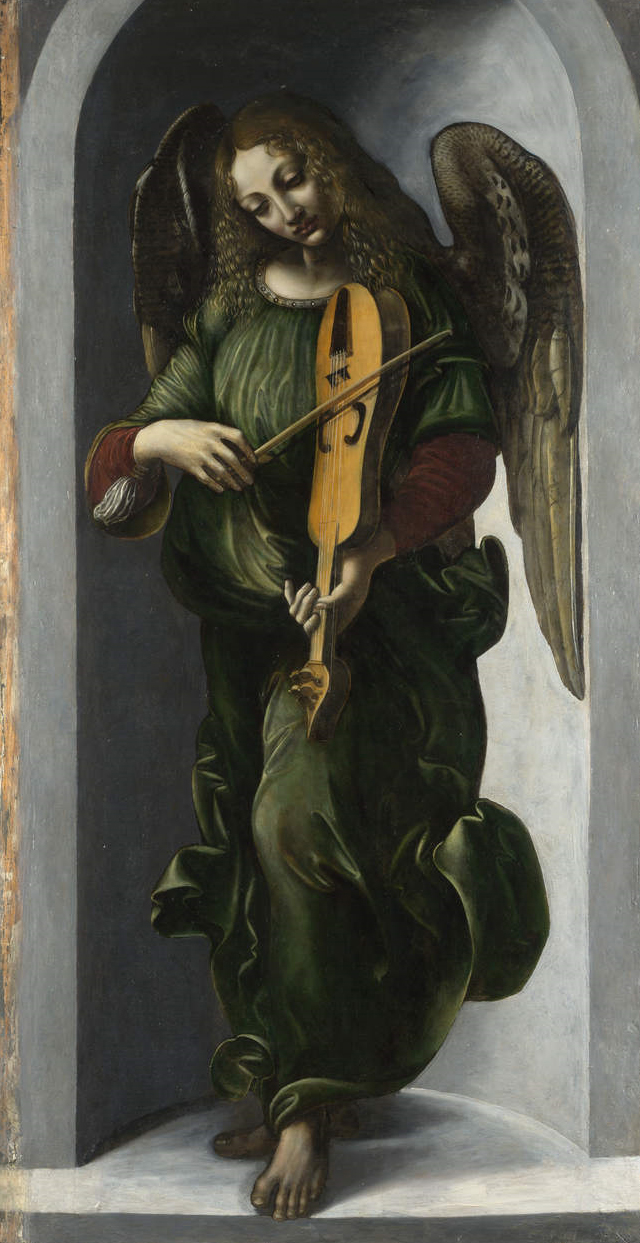
The Black Presence in Leonardo room was much more difficult to spot. It needed a wall plaque to find the Black Presence as it was in such a novel place - a woman’s belt buckle.The work in question looked very Northern Fourteenth century in style and composition - the profile of a dour lifeless, ashen faced woman painted in oil. What was missing was the detailed often crowded background with its obligatory window view found in most 15th century Northern portraits, this work has a very plain background it is attributed to Giovanni Ambrogio de Predi Profile Portrait of a Lady. Although its presence in the Room was supposed to be due to its artistic connection to the Leonardo the only connection I could think of was the fact that Ambrogio de Predi was one of the brothers who worked with Leonardo on The Virgin and the Rocks installation. They are mentioned in the 1483 contract for the work , as they were to help with painting and gilding and also paint the side panels with angels

Giovanni Ambrogio de Predi Profile Portrait of a Lady

The plaque revealed the Black presence:

The Moor's head and the letters 'L' and 'O' which ornament the buckle of the belt may allude to Lodovico il Moro, Duke of Milan
Without that note I would have missed this Black Presence completely as this is a very, very dark painting. To actually reveal it I needed the help of the National’s (excellent) web viewing tool to expand the painting coupled with a bit of cutting and pasting supported by Photoshop

Giovanni Ambrogio de Predi Profile Portrait of a Lady (detail)

The woman's identity is unknown but from the the buckle it can be inferred she was part of the court of Lodovico il Moro, Duke of Milan as the Moor’s head was a version of his device. The Moor’s head was never actually part of his heraldic coat nevertheless the Moor and his head has been found to be directly associated with him.

Elizabeth McGarth in her article Ludivico and his Moors suggests Ludovico had a seal of the head of a moor in profile with a headband which can be seen in the Black Presence on the courtier's buckle. She also identifies the device on a document granting a concession from Ludivico to the Crivelli Familiy.

Decorated Letter L with moor head and Crivelli Arms

A painted chest or cassone from 1488 has Ludivio sitting proudly on horse back in some form of pageant with his horse’s livery featuring the brush device in his coat of arms , followed by a black African attendant part of Ludivicos’ armed guard. The Black has the characteristic white headband, I will be returning to this emblem in a future post.

So the Black Presence was there you just had to look: one a conventional Black Magus the other the Moors head as an emblem. Two different uses of the Black Presence one as part of the Adoration entourage and the other as a device or symbol for a Renaissance Prince. I left the Gallery thruogh the gift shop and could not resist the challenge to find the Black - a 70p post card of The Adoration of the Kings 1598, Jan Brueghel the Elder...with strangely all the Blacks all looking away from the Virgin must find out why......

Jan Brueghel the Elder The Adoration of the Kings 1598 (detail)

Saturday, 4 June 2011

The Image is the Not the Object


It is three years to the month since I first visited my piece at the V&A and it is still in store, in the same place but this time the Black Magus was completely accessible. Then the rack could not be fully extended leaving the Black Magus trapped inside the cage, now the storage rack could be extended – not fully – but enough to expose the entire screen. Now I could see the Black Magus really close up - eye to eye - and take a decent picture.

My first impression, on this second visit, was how small, shabby and in need of repair it was as well as how very poor the painting really was. I had been looking at the V&A photograph and my own detail shots taken three years ago. While studying and contemplating the images I had totally ignored or failed to consider its physical condition to the same degree.

Having looked again at the photo, with the benefit of having seen the original again at first hand, I believe the V&A’s catalogue picture has been ‘Photoshopped.’ The rich golden corn ears of the mullions in the picture are quite dull and faded in the original, in fact all the colours are brighter, sharper in the V&A’s picture particularly the gold leaf, than those in the actual piece.

The framework has been repaired a number of times with replacement pieces added, there are cracks and some parts are broken or missing , while each of the four painted panels has vertical cracks along the grain. Comparing the three images - the V&A’s catalogue picture, my June 2008 and June 2011 pictures, the frame seems stable. The cracks do not appear to have increased or become wider or longer.

The image I had considered through photography was not the real, actual image. I was seeing what I wanted to see. In doing so I had effectively created two things the actual screen and my imagined screen. The latter had all that was the irrelevant removed - discolouration, blemishes, cracks , repairs, holes in the actual screen creating that ideal image in my head. With respect to René Magritte perhaps this is the image I should I have considered.

Acknowledgements
Thanks to the V&A staff for making my visit possible.
http://abarkleyfndcomp.blogspot.com/2011/04/final-project.html for the Magritte picture
John Berger and his BBC Television Series Ways of Seeing

Sunday, 13 March 2011

Launch Lecture for The Image of the Black in Western Art 2nd Ed

I had the great pleasure of attending the sell out lecture - Friday 25 February, - to launch the second edition of The Image of the Black in Western Art (theIBWA), held in the British Museum’s underground bunker that is the Clore Education Center.
The IBWA was one of the key text I had used in my research on the Black Magus so I was very much looking forward to the event. I was not disappointed. The event was introduced by Neil MacGregor the Director of the British Museum, former Director of the National Gallery and one of my favourite art historians. I find him a great communicator and enthusiast , and he has since risen even higher in my esteem as I have since discovered he has declined a knighthood. He underlined the importance of the role of British Museum as the original research by the first edition of the IBWA began with images from his institution.
The key note speakers were Professors Henry Louis ‘Skip’ Gates Jr and David Bindman , the joint general editors of the IBWA's second edition. They have complementary roles: Gates the cultural historian; Bindman the art historian. Gates, gave as you would expect from this accomplished speaker a witty and informative introduction to the second edition; his personal anecdotes brought the IBWA to life ; Bindman gave the authoritative, considered review of the IBWA positioning it in an historical, aesthetic context. They appeared to work well as a team - relaxed with each other- Gates passing on a particularly awkward question on race from the audience to Bindman which might have caused an embarrassed silence elsewhere, was handled with good humour, like two old friends having a row around a dinner table.
This was essentially Harvard University Press – the IBWA’s publisher – chance to big-up the book which they did big style! There were hundreds of copies of the second editions four volumes on display along with some great post cards and a beautiful, extremely high quality promotional brochure all attesting to the extremely high production values of the second edition.
I had no intention of buying a copy, let alone buying all four of the current volumes and accepting an option on the remaining six, as keep in mind each book is priced at £60 or more so that’s a non trivial commitment. The Gates, Bindman lectures had been very good but not enough to make me want to buy them at that price. However once I’d seen the books – their quality, their colour, their feel - found in picture after picture, essay after essay I was sold. As an art image book the IBWA is breath taking, page after page of stunning, revelatory pictures. When these pictures are seen against the scholarship of its essays , specifically the updated thinking in the second edition following new discoveries and interpretations such as Martin Bernal's "Black Athena" in the almost fifty years since the first edition, I was sold.
A special price on the night and a promise by the Harvard University Press to extend that deal to the other six volumes whenever they are published, sweetened the purchase as well as a chance to have them signed by the General Directors which I caught on camera......

Prof David Bindman (left) and Prof Henry Louis ‘Skip’ Gates Jr signing my copies of The IBWA


The Profs' signatures

Sunday, 26 December 2010

Three Sub-Saharan African Magi - An African Adoration


Les Rois Mages - The three Wise Men (Mt 2,1) (1)


My Christmas card this year came from a print on my Mum’s wall.

It is the Adoration set not in a stable at night in Italy but outside a mud hut in heat of the day in Sub Saharan Africa. With camels ,horses and their owners resting from the heat of the day in the shade of trees in the distance, in the foreground we have three richly attired Africans bearing gifts for a black baby Jesus, they are attended by a servant cooling them from that African heat. The baby Jesus is presented to the prestigious visitors by the Virgin and Joseph, both African, outside their mud hut with young boys playing traditional instruments to celebrate this illustrious meeting.

The image was both a surprise and delight to me.

It was a surprise, simply because I had subconciously succumbed to the cliché Renaissance image of the Adoration which itself was a fabrication in which the artist made it a contemporary scene, setting the Adoration in a place which was familiar to anyone living in Renaissance Italy, populating the image with figures attired in dress of the day - a totally fabricated but comtempory image.

It was a delight, as here is an artist trying to re-invent the Adoration scene in order to connect with a particular group of people - black , sub Saharan Africans. Just as we have many translations of the Bible aimed at different audiences so, why not have different images aimed at different groups? I am sure St Francis of Assis (1181/1182 – 1226) the originator of the images around the Nativity would have approved as this is simply Biblical education - evangelising the Jesus story.

St Francis believed in a world of vivid images designed to communicate the stories of the Christian faith to the congregation many of whose members could not read or write.....He felt that visual images could bring men closer to God and much of his preaching was fervently visual. (2)

The site I purchased the cards from has a common vision with St Francis, almost 900 years later:

It is urgent and necessary for us to proclaim and to express the message, the life and the whole person of Jesus-Christ in an African artistic language, in our language which is the expression of our daylife, of our culture (3).

This image never ceases to surprise and delight me after seeing so many with St Fancis’s Adoration images Jesusmafa's remains a revelation and source of great pleasure – Three Sub-Saharan African Magus - An African Adoration!

(2) Graham-Dixon, A., (1999), RENAISSANCE, BBC, ISBN 0-56337044-0
(3) P. Pondy , Direction Catholic Schools Yaounde,Cameroon


Sunday, 19 September 2010

Black In the Raphael Tapestries for Sistine Chapel ?


I had the great pleasure of seeing the Raphael Cartoons and Tapestries on show at the V&A to celebrate the Pope’s visit.I was even more delighted to spot what I believe to be a Black. You can find him in far left hand scene in the border of the Tapestry of Christ’s Charge to Peter see below.


The border tells the story of the expulsion of the Medici family, previously rulers of Florence, from the city in November 1494. Encouraged and supported by il Moro the Duke of Milan , ignored by The Pope (Rome), Venice and Naples, Charles VIII of France was ready to wrestle Florence from Medici power with little or no resistance from Florence , as it was left beleaguered by its neighbouring city states.

Cardinal Giovanni de’ Medici who was later to become Leo X – the Pope who commissioned the Cartoons for the Tapestries from Raphael – escaped during the night disguised as a Dominican monk in order to convey some of the Medici treasures. Those treasures he or his brother could not carry are shown being looted by a mob, represented as warriors in classical armour. The Black is shown helping carrying away some booty – see below.


The Black’s body is framed by an arched doorway, with his intricately woven head has two indistinct faces either side of it. He seems not to be wearing armour unlike others in front of him, his top appears to be made of cloth with torn sleeves in contrast to the looters. His nose is full and flared and he has characteristically negroid thick fleshy lips, unlike the Black Magus from Devon , this Black has been drawn by an artist who at least seen a black man, which is probably true as the Medici had black slaves. On the east wall panel of the Chapel of the Magi in Palazzo Medici frescoed by Benozzo Gozzoli a naturally depicted black slave livered in Medici colours is depicted leading the Patriarch’s mule.

The Black in the Tapestry’s border is further differentiated as unlike his co-patriots he is not wearing a helmet instead he is wearing what can only be described as a Rastafarian Tam. Further he is towards the back not leading the group, typical of the Black’s position in Renaissance paintings' compositions where the Black is normally towards the rear as in Giotto Black or the V&A’s Black Magus.

His poor dress in comparison to the others , his distinctive negroid facial characteristics , his odd head gear along with his position to the rear in the group as well as his typical blackman's raggedly beard further differentiate him from the group not just making him – ‘other’ , not one of ‘us’ but making him , to my eye, a Black.

Bibliography
Cardini, F. (2001) The Chapel of the Magi in Plazzo Medici, Mandragora, Florence
Evans, M. et al, (2010) RAPHAEL Cartoons and Tapestries for the Sistine Chapel, V&A Publishing, Italy
Hibbert, C. (1974) The Rise and Fall of the House of Medici, Penguin, St Ives