Wednesday, 13 March 2013

Black Magus in Birmingham


Adriaen Isenbrandt  Adoration of the Magi Triptych  (1510-12)
I had an hour or so to spare in Birmingham,  last Sunday so decided to visit its Art Gallery to see if any Renaissance Blacks were to be found.

It was quite easy, perhaps too easy, as the Gallery's paintings and sculpture were laid out chronologically. In its Medieval and Renaissance room I found an Adoration scene by Adriaen Isenbrandt (c1490 to 1551) with a characteristic Black Magus complete with earring. He was in a Adoration panel flanked either side - dexter (right!) panel The Annunciation and sinister (left!) panel The Circumcision. 


Adriaen Isenbrandt  Black Magus Detail
Isenbrandt‘s realistic, naturalistic style with much exquisite detail in all parts of the composition, in oil on oak, follows the style of two previous generations of Bruges artists :                      

1st  Generation Jan Van Eyck (c. 1395–1441) 

2nd Generation Hans Memling (1430 - 1494)

3rd Generation Adriaen Isenbrandt (c1490 to 1551)
The Black Magus presence most probably came from Isenbrandt‘s awareness of Hans Memling’s (1430 - 1494) influential Adoration work (see below), as Memling had done , for me, the definitive work that introduced the Black Magus presence into the Adoration composition to other Netherlandish artists of the period.

Memling’s Adoration was itself a variation of a work by his master Roger van den Weyden (c1400 - 1464) - van Wyden’s foppish young, White Magus is  substituted - fifteen years later - by Memling for an equally flamboyant young but Black Magus.

Rodger van den Weyden, Adoration of the Magi, oil on panel, c.1455

Hans Memling, Adoration of the Magi, oil on panel, c.1470-72,

Netherlandish rtists such as Hugo van der Goes (1440- 1482), Hieronymus Bosch (1450-1516) and Gerard David (active 1484; died 1523). Just like Adriaen Isenbrandt seem to have been aware of the Memling altarpiece with its Black Magus.


So, Adriaen Isenbrandt's Adoration Tryptch with its Black Magus takes its style from fifteenth century Bruges artistic traditions and its composition from Hans Memling to create a colourful, pleasing and typical Adoration with a Black Magus.

Adriaen Isenbrandt  Adoration Triptych Detail


Adriaen Isenbrandt  Adoration of the Magi Triptych (Detail) (1510-12)

Saturday, 9 February 2013

V&A’s AFRICA: SPEED SEARCH SOUND


Sadly, I never had the chance of my three minutes of fame, to be repeated three times, as part of the V&A’s AFRICA: SPEED SEARCH SOUND.

Feb 1st was, for me,  a chaotic day as I was exchanging and completing on the sale of my house on the same day having been given five days notice - or the deal was off!

There’s a cynical old project management saying - because half the time has passed does not mean half the job has been done. I've been selling my house for some time, so in principle I should have been set to go. Nevertheless there was much to do on that last day in order to hand the keys into the estate agent by 4pm that Friday and go on to be at the V&A for 6pm, for my three by three minutes of fame.

In short: happily, I made the former deadline, sadly, I missed the latter. The folk at the V&A where quite understanding and sympathetic, nevertheless I felt very bad, having let them down and I was personally,very disappointed.

So, for the record here's what I was going to say in my three minutes - the transcript of my three minutes.
 
This is a selection of 33 from 400 photographs by Walker Evans, a 32 year old American photographer who was commissioned by New York’s Museum of Modern Art – MOMA - to produce the photographic record of the objects displayed in the Museum’s 1935 exhibition – African Negro Art. 

Walker was noted for his photographs of sculptor, he documented the Depression and became one of the most influential photographers of the 20th century.

At the time MOMA was just six years old and was seeking to establish itself as THE gallery in New York to see Modernist painting and sculpture.

In African Negro Art MOMA wanted to demonstrate African Art’s influence on those Modernist sculptors and painters.

The curator of African Negro Art clearly saw that influence of African Art as he wrote about its :

...sensitiveness to material, freedom from naturalistic imitation and boldness of imagination [which] parallel many of the ideals of modern[ist] art.

That influence of African Art can be seen in Picasso’s Mademoiselle D'avignon; many believe him to be the greatest modernist painter and this his greatest work.
  
Handout to audience
The 600 plus works  came principally from west and central Africa - an area about the size of the United States, on loan from private and public collections across Europe and America including Picasso’s lifelong friend Henri Matisse, as well as Picasso’s dealer and champion Daniel Khanweiler but oddly no pieces from Picasso, himself.

The V&A’s curator's presentation of MOMA’s photographs shows how African Art can be both Art and Artifact – on one hand an object for aesthetic contemplation on the other an object of archaeological interest so the same objects may be exhibited in Art Galleries and Ethnological Museums. 
Documented Artifact - Archaeological Interest
Documented in a photograph with a number and label as an artifact, like a police mug shot or creatively lit and sensitively photographed by a leading photographer, mounted and framed as an art object – African Art is open to ambivalent understandings.
Framed Art Object - Aesthetic Contemplation
It is African Art’s supernatural combination of the sacred and the secular, the mysterious and the mundane that MOMA and modernist artist sensesed and for you to discover for yourself: African Negro Art -  Art or Artifact?

Thank you


Tuesday, 8 January 2013

Preparing for AFRICA: SPEED SEARCH SOUND


From MOMA collection - Les Demoiselles d'Avignon by Pablo Picasso (1881–1973)

While preparing for my talk I found that MOMA has its press releases on line so, I was delighted to discover the series of releases from February thru to March 1935 which led up to the opening of its African Negro Art exhibition and the commissioning of the photographs of its exhibits by the young, up and coming photographer of sculptor - Walker Evans.

The releases revealed (amongst other things):

The 603 pieces came from Europe’s African colonial powers – England, Germany, Belgium and France – and from some American collectors.

The list of collectors who loan work included:

The Artist                Henri Mattisi (Picasso's life long friend)
The Art Dealer        D H Kahnweiller (as well as his dealer, he championed Picasso)
The Museum            Musee d’ Ethnographie , Paris (Picasso visited here in 1907)

All very closely associated with Picasso – and yet Picasso denied ever having been influenced by African Art!
From V& A Collection: Polychrome mask, Ivory Coast, Walker Evans, 1903 - 1975

I recall visiting the Picasso Museum  in Barcelona which had a display dedicated to his figurative design development of the mask shapes found in his seminal 1907 work Les Demoiselles d'Avignon. According to the drawings this development was based solely on the leaf as inspiration shape for the face – nothing to do with African Religious Masks.......

An alternative source for the masks in Picasso’s work is given by Ingo Walther in his Picasso Monogram for Taschen. In which he argues Picasso discovered the figurative design for himself , by himself. Walther uses a 1907 sketchbook as proof.

I am not persuaded, I believe Picasso was principally inspired by the African religious masks he saw at the Ethnographic Museum in Paris which he visited in 1907.

Meanwhile the research and preparation continues.

Thursday, 3 January 2013

Speaking at the V&A


I have been invited to speak at Victoria and Albert Museum's AFRICA:SPEED,SEARCH, SOUND Feb 1st. I have chosen to talk about Walker Evans's 1935 'African Negro Art' photographs for MOMA.

Looking forward to discussing what's the difference between art and artefact between Oxford's Pitt Rivers Musuem and London's Tate Modern presentation of 'African Negro Art'.

Friday, 7 December 2012

My 2012 Christmas Card Contest

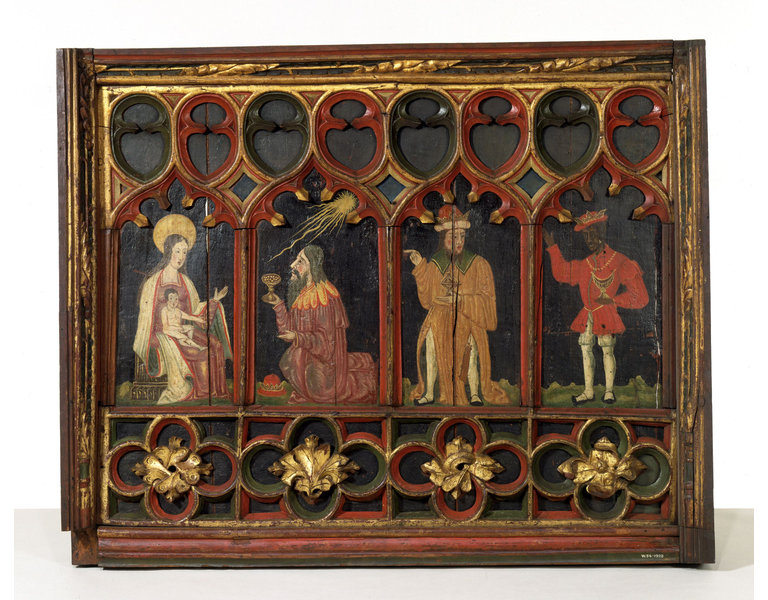
It's that time of year again, when I ideally like to choose a Black Magus image for my Christmas card. In the past I've used variants of my Adoration Rood Screen -  in whole and details, that worked for 2008 and 2009 and for 2010 I used the three sub-Saharan African Adoration card.

This year I hadn't a clue what to use so devised a particularly poor research technique -I googled The Three Kings followed by  Drei Könige and looked at what images turned up. I was not disappointed. I was inundated -  many clichĂ©s, much kitsch but a few did stand out.....


> A 15th Century Ethiopian Triptych

Madonna and Child triptych from fifteenth century Ethiopia, recently cleaned by the Ethiopian Heritage Fund.

Fifteenth Century Panel from Monastery of St. Stephen , Hayq, Ethiopia
Medium: Painted wooden panel: Size (central panel) approx : 36" x 24" Date: Fifteenth Century from the Monastery of Saint Stephen, Hayq, Ethiopia

This work was a total surprise quite unlike any image in the many hundreds the Google searches presented - visually stunning, ichnographically intriguing - I've seen nothing quite like it before. A nappy haired Jesus set in a medieval triptych frame, in a Greek icon composition surrounded by haloed saints and a donor - extraordinary conflation of concepts and ideas.

I plan to return to this work, to study it in more detail meanwhile I will leave it as a contender for my 2012 Christmas Card image.


> The Three Kings by Richard Hook

The Three Kings by the illustrator and artist: Richard Hook (1938–2010)

The Three Kings ,1972, Richard Hook (1938- 2010)
Medium: Pen & Ink on Board: Size: 6" x 6" (160mm x 140mm): Date: 1972
The illustration was used in the Look and Learn Annual 1972 and later sold from here

A dramatic, tight, compact work;  although the rest of Adoration scene  is out of picture its presence is sensed from  the united and intense gaze of the three magi all leaning, pressing  forward to present their gift to the infant  Christ – their gifts and bejewelled fingers indicating where Christ is to be found.
One composition discussion point is the location of the Black Magus at the head of the trio. The Black Magus image during the Renaissance  was conventionally at the rear of the trio, often isolated or separated by space or a barrier


> The 3 Wise Men by Hilke MacIntyre

An edition of 50 painted modern ceramic plaques portraying the three kings:

The 3 Wise Men, Hilke MacIntyre
Medium: ceramic relief, edition of 50: Size: 3 parts, each 11.5 x 5 cm  Date: Twenty-First Century

A lovely modern rendition of the three magi by Hilke MacIntyre  sadly (for me, not the artist!) it is sold out. I was intrigued that the artist moved the Black Magus around in the group as he hand painted each edition individually.

Interestingly, the MacIntyre's Magi gaze is directly ahead indicating that the viewer is the subject of that gaze or put another way they (we) are the Madonna and Child!

-------------------------------------------------------------------------------------------------------------------
> and the Winner is.....Richard Hook's The Three Wise Men!
In the end it was an easy decision as I was totally enamoured by the drama in the piece, its modernist tension in the compressed picture plane is palpable - it's been my iPad Lock Screen and Wallpaper for the past month. 
So, friends and family will receive Richard Hook's The Three Wise Men printed by moo cards, delivered in a festive red envelope with an appropriately themed stamp.....hopefully sometime before the 25th!
--------------------------------------------------------------------------------------------------------------------
..and some after thoughts.....

There were a number of images which didn't make the short list but nevertheless I found interesting:

The Post Office's 1994 Christmas 25p stamp:


Brussels Grand Place 2012  nativity scene:


The nativity scene in my Mum's nursing home's nativity scene which had two Virgins and two Josephs as well as not one Magus but three Black Magi and one white Magus, a very crowded Nativity!


This image wasn't a contender in fact it was a real shock - a blacked up Black Magus - St. Gordian Epimach, Germany receiving Angela Merkel Christmas 2011:


Sunday, 21 October 2012

Spoke at the British Library


I spoke last Friday Oct 19th at the British Library as part of their Readers Research program  the evening’s topic was chosen to coincide with Black History Month – Blacks in Renaissance Britain.

Miranda Kaufmann Presenting
I shared the platform with Dr Miranda Kaufmann ;  the session  was chaired by Dr Caroline Bressey from the UCL Equiano Centre.

I was surprised and delighted  to find the evening was a complete sell out – people had paid good money to hear me talk quite a novel experience; perhaps  testament to the growing interest in Blacks in this period.

FullHouse
The format of the evening was simple;  Miranda and I each gave a 20 minute talk followed by a question session from Caroline then it was thrown open to questions from the audience.

I spoke about my experience of writing my Open University Independent Essay in the summer of 2008 followed by an overview of the  essay - essentially the history of this blog. You can read a transcript here and download my presentation.

Miranda‘s talk was intriguingly entitled:

135 Africans  in a Bristol barn for week in 1590, or what I’ve Learned at the British Library...

It was both  entertaining and  interesting, as she revealed some of her findings from the British Library’s Archives. She presented  these 135  ‘Neagros’  with some matter of fact detail of their stay in Bristol she'd teased from the archives . For example the budget for their ‘victualls and diett’ was 4d – four old pence about 1.67 new pence –per man per day. I discovered later that’s  around £33 in today’s money . She also pointed out that this compared to 6d per day per man for the 32 ‘Portingales and Spaniardes’ taken into custody from the same ship at the same time.

The Q&A session raised a couple of issues I plan to consider further:
1 Questions  around black history what is it and what it means
2 Why African Ambassadors were sent to Europe's courts during the period, no Kings or Queens followed on?
Both will be the subject of forthcoming posts.

For more information about Miranda’s research see her web site. She has done some original and ground breaking work in discovering 350 Africans in Britain 1500 to 1640. Tantalizingly, I’ve had the privilege of access to parts of her doctoral  thesis on those 350 Africans so, I very much looking forward to the book when  it’s published.

One last point I discovered from Miranda’s presentation that she and I were doing our research at the British Library at the same time – Summer 2008 – yet didn’t actually meet till 2011. It would be quite useful  if the British Library could find some way of bringing  Readers on the same subject  together – if they , the Readers, want to that is(!) – a cross between a Dating Agency and Friends Reunited site based on Readers Research subjects, maybe?

All in all a great honour and privilege  to share my  thoughts and ideas on Blacks in Renaissance Europe with an interested  and engaging  fellow presenter , chair and audience at  the home of ‘the World’s Knowledge’.

Friday, 21 September 2012

Great Malvern's retouched Black Magus

The image of the Black Magus in Great Malvern Priory was first described   to me rather grandly as  ‘the first possible representation in Britain in the modern age of a [B]lack person’ When I finally saw an on-line version of the  image  I questioned its  Black presence,  as I will indicate, initially it did not tick all my boxes for it  to be considered a Black Magus. It was not until I saw the original image in Great Malvern Priory that I changed my mind and had my doubts allayed.
On-Line Image
The first version of this image I saw was on the web at Philip Wilkinson’s English Buildings blog , Philip describes the work’s composition  in some detail but makes no reference to any notable characteristics of the third Magus other than he is ‘raising his left hand.’Emeritus Prof David Bindman Prof Bindman on the other hand, makes the claim that the third Magus at the rear of the composition ‘ does seem to have darker face than the other figures'.  Oddly, considering his chapter on ‘The Black Presence in British Art: Sixteenth and Seventeenth centuries’ appears in a book entitled The Image of the Black Western Art, he does not include an  ‘Image’ of the work he claims to be ‘the first possible’ image. (I raised this omission with Prof Bindman you can read our correspondence here). 

I studied the on-line image and wasn’t convinced in fact I wrote to a friend:

This to my mind isn't a Black Magus as he does not look like any Black Magus I've seen.
He does not look black -  a little ruddy but his overall  complexion is almost as light as the other Magi
He has no flamboyant poise
He has no excessive jewellery
His clothing is not extravagant, it is far too similar to the other two magi - note the slit and leg
.....and he is not wearing an earring! 
The actual image I encountered  in Great Malvern Priory was very different from its on line doppelgänger.

Actually finding the Adoration  images's window in the Priory was not easy, as I had not done sufficient research prior to my visit. All that I brought with me was my understanding that there was an Adoration scene to be found  somewhere in Priory's stained glass windows.

It's an understatement to say that there is a lot of wonderful, colourful stained glass in the Priory. It wasn't quite looking for a needle in a hay stack - but it was close! With the help of the enigmatically titled but hugely helpful Deputy Custdos, I was able to find the Adoration scene amongst the North Aisle's stained glass and take my photographs

Great Malvern Stained Glass Image
The Great Malvern Priory Adoration scene is part of the now, solitary medieval Window in the North Aisle. Once there were five cusped gothic ogee lights/windows filled with nearly sixty biblical images illustrating Gospel history, dating from around 1490. The few plates that survived were collected in 1919 into the fourth window of the North  Aisle.

Medieval Window in North Aisle
The Annunciation * The Visitation * The Nativity
The Adoration * Jesus in the Temple * Temptation of Jesus
Jesus at the Pool of Bethesda * Healing the Sick * Healing a Dumb & Deaf Man
Healing the Leper and the Centurion's Servant * Marriage of Joachim & Anne * Annunciation of Anne

They were used to educate at time when few could read. The images were most likely taken from two widely distributed picture books at that time:
Biblica Pauperum (The Poor Man’s Bible)
Speculum Humanae Salvationis  (Mirror of Man’s Salvation).
These are the pattern books of the day; Jan Van Eyk was understood to have a copy of the Biblica Pauperum just like today Jack Vettriano  uses pattern books – but with very different out comes. Van Eyk is venerated by the art historians and critics while Vettriano's paintings are snubbed and critics are indifferent to his work.  

Adoration images are to be found in both books:

Biblica Pauperum - Adoration

Speculum Humanae Salvationis - Adoration
Interestingly the Speculum Humanae Salvationis  has a Black Magus…..another research opportunity! The  Adoration image above comes from a British Library  page from Biblica Pauperum. Great Malvern's Adoration composition is very similar to the Biblica Pauperum's Adoration


I would argue that when you compare the stained glass image with the web image you will be challenged to make the leap from the apparently translucent skin of the stained glass Magus to the dark swarthy skin of the web image. That difference in colour I believe is a result of their very different media. These colour differences are not in the skin of the third Magus but all over the image there are marked differences in a colour’s density and tone from one image to the other.

These differences are because one is a digital image, a photographic reproduction of a book cover while the other is a stained glass window. So we are comparing a photograph with a piece of stained glass.

One is viewed by reflected light while the other is viewed by transmitted light. 

Transmitted light can fundamentally change the way the stained glass image appears. This change in appearance is dependent on the colour, quantity and quality of the transmitted light, these changes produce the essential characteristic of stained glass's range of dazzling effects – radiant, lustrous,  dramatic – dependent on the light so sunny days, cloudy days each produces their own lighting effects.

Position of the Adoration Plate Glass

Sun's movement Over the Great Malvern Priory
So, a stained-glass window’s position in the church as well as the time of day and time of year all impact how the work appears: for example Great Malvern’s magnificent East Window – the largest in any parish church in England  – is an ‘arabesque of beautiful colour’ when viewed in the early morning sun.

The web image is a copy of a colour plate from a 1947 book on the Priory's Medieval Window which was also the cover of the book.   

Side by side comparison of the glass with the plate shows how the plate has been  modified. The plate’s colours appear flatter, more muted with none of the lustre of the stained glass. It could be argued that printing techniques  at that time (1947) could not capture these lighting subtleties found in stained glass.

Whoever prepared the plate went further,  almost painting by numbers filling colours, enhancing some lines and removing others – notably the horizontal dark line made by the grill protecting the window. Having said that when the plate was made there probably was no protective grill in place.


The most clumsy enhancement of the plate is the colouring of the Third Magus’s skin and for me the most devastating and telling is the painting over of the Black Magus’s  earring,  visible in the glass painted out  in the plate !

To conclude, I agree that despite his dress his position , his facial characteristics and his earring all indicate to me that this is a Black Magus. Whether or not he is the earliest image in Britain that’s another story!

Bibliography
Hamand, L.A. (1947) , The Ancient Windows of Great Malvern Priory Church, The Campfield Press, St. Albans
Rushforth, G. McNeil, (1936) Medieval Christian Imagery as Illustrated by the Painted Windows of Great Malvern
Priory Church, Oxford
Wells, K. (2009) Tour of Great Malvern Priory, The Friends of Great Malvern Priory, Great Malvern