I had a few spare moments while in central London the other day so decided to pop into the National Gallery as it has been some time since I last visited this national treasure. As usual I was on the look out for the Black Presence - I was not disappointed. I found two, one obvious the other not so obvious and their presences came from two different traditions.
Since my last visit the National’s curators have moved things around as I came across quite by chance two of the National's most iconic paintings - Leonardo’s The Virgin and the Rocks and Holbein's The Ambassadors. They were in small, intimate rooms in the basement accessed without drama, in contrast to the positions I had known them to be hung previously. The Ambassadors used to be visible, from a distance, on one of the main axis of the Gallery, The Virgin and the Rocks had at one time dominated the entrance space to the Sainsbury Wing; now both were in much smaller spaces.
The hang in both rooms is balanced and visually pleasing with the masterwork dominating its room flanked by lesser - in size and in skill - works from contemporary artists Time did not permit an in depth study of the Holbein room other than just a cursory look - enough to find the Black Presence. The Ambassadors contains no Black Presence to my knowledge but this is a complex detailed painting focused study might well reveal a connection - perhaps a future blog post. The Black Presence in the room was very easy to find it was the Black Magus in Bartholomaeus Spranger’s The Adoration of the Kings. This was a conventional traditional presence The Black Magus with black attendant is positioned towards the edge of the composition in a strutting almost arrogant pose, complete with outlandish clothes in colour and cut and single earring, all underlining his exotic otherliness.
 Bartholomaeus Spranger’s The Adoration of the Kings (detail)
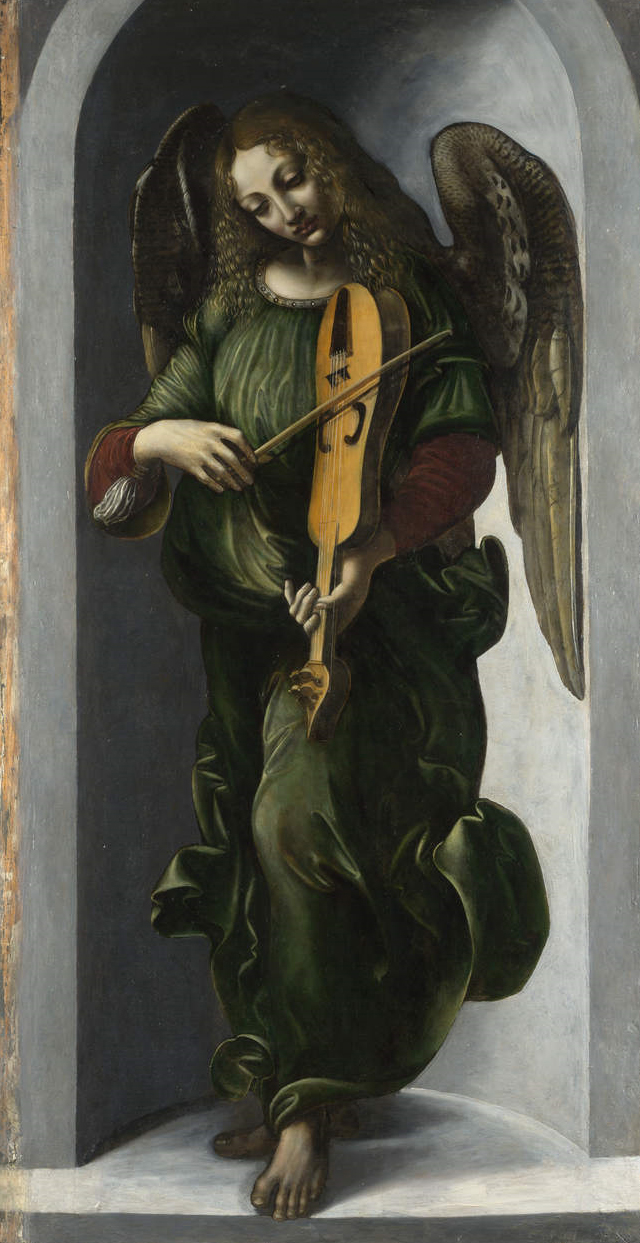
The Black Presence in Leonardo room was much more difficult to spot. It needed a wall plaque to find the Black Presence as it was in such a novel place - a woman’s belt buckle.The work in question looked very Northern Fourteenth century in style and composition - the profile of a dour lifeless, ashen faced woman painted in oil. What was missing was the detailed often crowded background with its obligatory window view found in most 15th century Northern portraits, this work has a very plain background it is attributed to Giovanni Ambrogio de Predi Profile Portrait of a Lady. Although its presence in the Room was supposed to be due to its artistic connection to the Leonardo the only connection I could think of was the fact that Ambrogio de Predi was one of the brothers who worked with Leonardo on The Virgin and the Rocks installation. They are mentioned in the 1483 contract for the work , as they were to help with painting and gilding and also paint the side panels with angels
The plaque revealed the Black presence:
The Moor's head and the letters 'L' and 'O' which ornament the buckle of the belt may allude to Lodovico il Moro, Duke of Milan
Without that note I would have missed this Black Presence completely as this is a very, very dark painting. To actually reveal it I needed the help of the National’s (excellent) web viewing tool to expand the painting coupled with a bit of cutting and pasting supported by Photoshop

Giovanni Ambrogio de Predi Profile Portrait of a Lady (detail)
The woman's identity is unknown but from the the buckle it can be inferred she was part of the court of Lodovico il Moro, Duke of Milan as the Moor’s head was a version of his device. The Moor’s head was never actually part of his heraldic coat nevertheless the Moor and his head has been found to be directly associated with him.
Elizabeth McGarth in her article Ludivico and his Moors suggests Ludovico had a seal of the head of a moor in profile with a headband which can be seen in the Black Presence on the courtier's buckle. She also identifies the device on a document granting a concession from Ludivico to the Crivelli Familiy.

Decorated Letter L with moor head and Crivelli Arms
A painted chest or cassone from 1488 has Ludivio sitting proudly on horse back in some form of pageant with his horse’s livery featuring the brush device in his coat of arms , followed by a black African attendant part of Ludivicos’ armed guard. The Black has the characteristic white headband, I will be returning to this emblem in a future post.
So the Black Presence was there you just had to look: one a conventional Black Magus the other the Moors head as an emblem. Two different uses of the Black Presence one as part of the Adoration entourage and the other as a device or symbol for a Renaissance Prince. I left the Gallery thruogh the gift shop and could not resist the challenge to find the Black - a 70p post card of The Adoration of the Kings 1598, Jan Brueghel the Elder...with strangely all the Blacks all looking away from the Virgin must find out why......

Jan Brueghel the Elder The Adoration of the Kings 1598 (detail)