Sunday, 21 October 2012

Spoke at the British Library


I spoke last Friday Oct 19th at the British Library as part of their Readers Research program  the evening’s topic was chosen to coincide with Black History Month – Blacks in Renaissance Britain.

Miranda Kaufmann Presenting
I shared the platform with Dr Miranda Kaufmann ;  the session  was chaired by Dr Caroline Bressey from the UCL Equiano Centre.

I was surprised and delighted  to find the evening was a complete sell out – people had paid good money to hear me talk quite a novel experience; perhaps  testament to the growing interest in Blacks in this period.

FullHouse
The format of the evening was simple;  Miranda and I each gave a 20 minute talk followed by a question session from Caroline then it was thrown open to questions from the audience.

I spoke about my experience of writing my Open University Independent Essay in the summer of 2008 followed by an overview of the  essay - essentially the history of this blog. You can read a transcript here and download my presentation.

Miranda‘s talk was intriguingly entitled:

135 Africans  in a Bristol barn for week in 1590, or what I’ve Learned at the British Library...

It was both  entertaining and  interesting, as she revealed some of her findings from the British Library’s Archives. She presented  these 135  ‘Neagros’  with some matter of fact detail of their stay in Bristol she'd teased from the archives . For example the budget for their ‘victualls and diett’ was 4d – four old pence about 1.67 new pence –per man per day. I discovered later that’s  around £33 in today’s money . She also pointed out that this compared to 6d per day per man for the 32 ‘Portingales and Spaniardes’ taken into custody from the same ship at the same time.

The Q&A session raised a couple of issues I plan to consider further:
1 Questions  around black history what is it and what it means
2 Why African Ambassadors were sent to Europe's courts during the period, no Kings or Queens followed on?
Both will be the subject of forthcoming posts.

For more information about Miranda’s research see her web site. She has done some original and ground breaking work in discovering 350 Africans in Britain 1500 to 1640. Tantalizingly, I’ve had the privilege of access to parts of her doctoral  thesis on those 350 Africans so, I very much looking forward to the book when  it’s published.

One last point I discovered from Miranda’s presentation that she and I were doing our research at the British Library at the same time – Summer 2008 – yet didn’t actually meet till 2011. It would be quite useful  if the British Library could find some way of bringing  Readers on the same subject  together – if they , the Readers, want to that is(!) – a cross between a Dating Agency and Friends Reunited site based on Readers Research subjects, maybe?

All in all a great honour and privilege  to share my  thoughts and ideas on Blacks in Renaissance Europe with an interested  and engaging  fellow presenter , chair and audience at  the home of ‘the World’s Knowledge’.

Friday, 21 September 2012

Great Malvern's retouched Black Magus

The image of the Black Magus in Great Malvern Priory was first described   to me rather grandly as  ‘the first possible representation in Britain in the modern age of a [B]lack person’ When I finally saw an on-line version of the  image  I questioned its  Black presence,  as I will indicate, initially it did not tick all my boxes for it  to be considered a Black Magus. It was not until I saw the original image in Great Malvern Priory that I changed my mind and had my doubts allayed.
On-Line Image
The first version of this image I saw was on the web at Philip Wilkinson’s English Buildings blog , Philip describes the work’s composition  in some detail but makes no reference to any notable characteristics of the third Magus other than he is ‘raising his left hand.’Emeritus Prof David Bindman Prof Bindman on the other hand, makes the claim that the third Magus at the rear of the composition ‘ does seem to have darker face than the other figures'.  Oddly, considering his chapter on ‘The Black Presence in British Art: Sixteenth and Seventeenth centuries’ appears in a book entitled The Image of the Black Western Art, he does not include an  ‘Image’ of the work he claims to be ‘the first possible’ image. (I raised this omission with Prof Bindman you can read our correspondence here). 

I studied the on-line image and wasn’t convinced in fact I wrote to a friend:

This to my mind isn't a Black Magus as he does not look like any Black Magus I've seen.
He does not look black -  a little ruddy but his overall  complexion is almost as light as the other Magi
He has no flamboyant poise
He has no excessive jewellery
His clothing is not extravagant, it is far too similar to the other two magi - note the slit and leg
.....and he is not wearing an earring! 
The actual image I encountered  in Great Malvern Priory was very different from its on line doppelgänger.

Actually finding the Adoration  images's window in the Priory was not easy, as I had not done sufficient research prior to my visit. All that I brought with me was my understanding that there was an Adoration scene to be found  somewhere in Priory's stained glass windows.

It's an understatement to say that there is a lot of wonderful, colourful stained glass in the Priory. It wasn't quite looking for a needle in a hay stack - but it was close! With the help of the enigmatically titled but hugely helpful Deputy Custdos, I was able to find the Adoration scene amongst the North Aisle's stained glass and take my photographs

Great Malvern Stained Glass Image
The Great Malvern Priory Adoration scene is part of the now, solitary medieval Window in the North Aisle. Once there were five cusped gothic ogee lights/windows filled with nearly sixty biblical images illustrating Gospel history, dating from around 1490. The few plates that survived were collected in 1919 into the fourth window of the North  Aisle.

Medieval Window in North Aisle
The Annunciation * The Visitation * The Nativity
The Adoration * Jesus in the Temple * Temptation of Jesus
Jesus at the Pool of Bethesda * Healing the Sick * Healing a Dumb & Deaf Man
Healing the Leper and the Centurion's Servant * Marriage of Joachim & Anne * Annunciation of Anne

They were used to educate at time when few could read. The images were most likely taken from two widely distributed picture books at that time:
Biblica Pauperum (The Poor Man’s Bible)
Speculum Humanae Salvationis  (Mirror of Man’s Salvation).
These are the pattern books of the day; Jan Van Eyk was understood to have a copy of the Biblica Pauperum just like today Jack Vettriano  uses pattern books – but with very different out comes. Van Eyk is venerated by the art historians and critics while Vettriano's paintings are snubbed and critics are indifferent to his work.  

Adoration images are to be found in both books:

Biblica Pauperum - Adoration

Speculum Humanae Salvationis - Adoration
Interestingly the Speculum Humanae Salvationis  has a Black Magus…..another research opportunity! The  Adoration image above comes from a British Library  page from Biblica Pauperum. Great Malvern's Adoration composition is very similar to the Biblica Pauperum's Adoration


I would argue that when you compare the stained glass image with the web image you will be challenged to make the leap from the apparently translucent skin of the stained glass Magus to the dark swarthy skin of the web image. That difference in colour I believe is a result of their very different media. These colour differences are not in the skin of the third Magus but all over the image there are marked differences in a colour’s density and tone from one image to the other.

These differences are because one is a digital image, a photographic reproduction of a book cover while the other is a stained glass window. So we are comparing a photograph with a piece of stained glass.

One is viewed by reflected light while the other is viewed by transmitted light. 

Transmitted light can fundamentally change the way the stained glass image appears. This change in appearance is dependent on the colour, quantity and quality of the transmitted light, these changes produce the essential characteristic of stained glass's range of dazzling effects – radiant, lustrous,  dramatic – dependent on the light so sunny days, cloudy days each produces their own lighting effects.

Position of the Adoration Plate Glass

Sun's movement Over the Great Malvern Priory
So, a stained-glass window’s position in the church as well as the time of day and time of year all impact how the work appears: for example Great Malvern’s magnificent East Window – the largest in any parish church in England  – is an ‘arabesque of beautiful colour’ when viewed in the early morning sun.

The web image is a copy of a colour plate from a 1947 book on the Priory's Medieval Window which was also the cover of the book.   

Side by side comparison of the glass with the plate shows how the plate has been  modified. The plate’s colours appear flatter, more muted with none of the lustre of the stained glass. It could be argued that printing techniques  at that time (1947) could not capture these lighting subtleties found in stained glass.

Whoever prepared the plate went further,  almost painting by numbers filling colours, enhancing some lines and removing others – notably the horizontal dark line made by the grill protecting the window. Having said that when the plate was made there probably was no protective grill in place.


The most clumsy enhancement of the plate is the colouring of the Third Magus’s skin and for me the most devastating and telling is the painting over of the Black Magus’s  earring,  visible in the glass painted out  in the plate !

To conclude, I agree that despite his dress his position , his facial characteristics and his earring all indicate to me that this is a Black Magus. Whether or not he is the earliest image in Britain that’s another story!

Bibliography
Hamand, L.A. (1947) , The Ancient Windows of Great Malvern Priory Church, The Campfield Press, St. Albans
Rushforth, G. McNeil, (1936) Medieval Christian Imagery as Illustrated by the Painted Windows of Great Malvern
Priory Church, Oxford
Wells, K. (2009) Tour of Great Malvern Priory, The Friends of Great Malvern Priory, Great Malvern


Wednesday, 9 May 2012

Ludlow's St Laurence's Gift Shop and its Black Magus


Once a year for the past few years I’ve been on a walking weekend, around this time , with five friends of a certain age who share the vagaries of a lived life with an interest in life , the Universe and everything  – a chance to walk and  talk, drink and talk  and eat and talk.

St Laurence Ludlow Parish Church

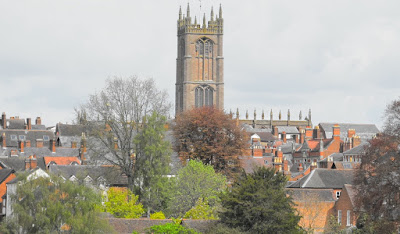
This year  we went to Ludlow ‘the loveliest town in England’ if Sir John Betjamn is to be believed , ‘ an architecturally, beautiful and thriving market  town [whose] street layout remains essentially that of a mediaeval  town’ according to the Visitor Centre’s leaflet.

Those epithets and the beautiful walks in the surrounding hills with their many spectacular views went some way to answering the question on my mind ‘Why Ludlow?’  However, that question  was completely answered when I found a Black Magus in Ludlow’s historic  parish church St Laurence ‘cathedral of the Marches’!

Even though it was given five stars by Simon Jenkins England's Thousand Best Churches, one of only 18 such churches which made his  long list from England’s 8,000 plus churches, I initially left St Laurence’s disappointed not just because I was unable to find a Black Magus but I found the church over renovated, over restored and over conserved. Coincidentally the cover of Jenkin's 2000 paperback edition of his guide takes its cover's details from the upper registers of St Laurence's  Palmers' Window  

For me , St Laurence was all little too bright and shiny, cleaned and polished and beautifully presented. None of the patina, wear and tear with a some dirt and a little decay to be found in other 600 year old plus English country churches. I believe the overly polished presentation reflects the central part St Laurence has played in this wealthy community – the money has always been there for the church’s upkeep.

In St Laurence I was minded of the Queen’s Gallery just beside Buckingham Palace where the immaculate, pristine appearance of, not just,  the building and its staff  but also the overly restored, renovated and conserved paintings makes for a clinical, sterile environment lacking in  any distinctive character or personality.

The nativity Group with the Black Magus the middle of the three Magi on the right

I found the Black Magus in a photo taken not in the Church but, in its well stocked Gift Shop - seemingly an integral part of the Church. I took the photo to record a nativity collection similar in concept to a collection of figures I had seen in Dortmund, Germany . However, Ludlow’s Nativity Scene’s was cheaper  and was  plastic not wood like Dortmund’s putting it in a different (lower) quality league and crucially it appeared not to have a Black Magus., as at first glance all the kings seemed white.

                                                                                     The Black Magus highlighted

However , later, whilst examining the picture I was surprised and delighted to spot the earring on the middle Magus then I became aware of his slightly darker skin colour compared to the other two Magi. I had found a Black Magus in St Leonards so the visit was not without its reward.

Ludlow Magus (centre) compared with two carved  Black Magi /  König Mohr

Ludlow’s Black Magus was in the same style of other contemporary carved and painted Black Magus - König Mohr brought for me as a present at the Christmas Market in Dortmund.

There is a Germanic tradition cum industry of carving Nativity scene characters – Holy Family, Kings & Comets, Angels, Shepherds and Children, Animals and Sables -  whose roots go back centuries. Generations of wood carvers have been involved in this family business have a look here or here – the spirit of Tilman Riemenschneider continues  to this day. From today’s carvers one can pay as little as 20 Euro for a 3.5inch high plain finish  König Mohr   or nearly 3,000 Euro for a hand painted 36inch high Konig.

Stalls selling theoe carved biblical characters play a central part in the Germany's Christmas Markets one of the oldest is Holzschnitzerei -Josef Albl - whose catalog's breadth and depth is breath taking and the company traces its roots directly from 1556 to this very day!

Ludlow’s Black Magus  is of great interest to me as is shows how a tradition which dates back to the fifteenth century is very much alive not just in Germany the home of the König Mohr but here in the UK.

------------------------------------------------------------------------------------------------------------

An Aside......

There is a Black angel in the carved Baroque version of the Nativity scene. Raphel’s putti have been transformed into an entire angelic putti orchestra, for example. I own a Black Putti myself.


Saturday, 19 November 2011

St Maurice Black or White?


Had an excellent day at the Victoria and Albert museum Spotlight on the Diaspora  gave my St Maurice presentation twice. Met some lovely people. Here's the transcript of my talk.  The second time was a literally last minute, hurried affair, without my most important prop the image of Magdeberg's St Maurice  - given as the Victoria and Albert attendants were closing the museum down around us - for those who had missed the first.

All the Victoria and Albert staff were brillant very flexible , enthusiastic  and supportive made my presentation(s) go so well so, a big thanks to them all.

Apart from how well the idea that the Victoria and Albert's St Maurice was really black was aceppted - despite its apparent whiteness - and why. My other take away was VuVox billed as:

A Virtual Gallery in Four Pictures [from Spotlight on Africa and the Diaspora] [time] 13.30 – 16.30[venue] Digital Studio [Sackler Wing]Use your camera or one of ours to take your own creative photographs of your 4 favourite Spotlight objects.  Then upload your images and design your own virtual gallery with a story or captions. 

The result you see above - a cross between a collage, a video , a picture and a panorama - a VuVox aka collvidpicpan - the one above is my first attempt. I believe this to be a brilliant idea, much better more accessible, a creative alternative to Prezi, Apple's Keynote or Microsoft's PowerPoint for making web based presentations.

All in all a good day.


Sunday, 6 November 2011

Does Saint Maurice have to be black to be Saint Maurice?


Victoria and Albert  St Maurice v Magdeberg Cathedral St Maurice
I was delighted when I was invited by the Victoria and Albert Museum to comment on the image  of St Maurice as part of their Spotlight on Africa and the Diaspora program . The St Maurice In Magdeberg cathedral was one of the earliest (to me) and most dramatic images of a Black In Renaissance in Europe I discovered when I started this blog.

I was surprised when I saw the actual St Maurice I’d been invited to discuss with a V&A curator, this was not a 
St Maurice image in the Magdeberg style , this image was the like no St Maurice I’d seen so  far (see images below) - this St Maurice  looked distinctly  European.

Sixteenth Century St Maurices from German Influenced Areas
Subsequent research gave possible reasons as to why in Germany at that time an apparently white St Maurice could be appreciated when the overwhelmingly accepted image was black. Nevertheless this white St Maurice forced me to consider, did St Maurice need to be look black for me to see him as black, the V&A's St Maurice has curly hair but no other visible signs of blackness, is that enough, to be black do you have to look black ?

Discussing the question with friends - black and white - brought up the same question but this time colour inverted - do you have to look white to be white? That's what I wrote about in my response to V&A's St Maurice in the brochure to support the Spotlight on Africa and the Diaspora program:


I must have said something right (or controversial) as I've been invited to present the V&A's St Maurice and my response in front of the piece - for 40 minutes on the 19th November.

This invitation has prompted me to dig deeper into the background of the V&A's St Maurice, its creator and his times, I plan to write about my findings in the next post.

Sunday, 21 August 2011

Taken Back to My Comparative Roots

Holy Trinity Church, Long, Melford, Suffolk

The outcome of my visit to Suffolk’s fifteenth century Holy Trinity Church at Long Melford in search of more Renaissance Blacks was a very pleasant surprise. Although I did not identify any Renaissance Blacks, I did find one Black , more of that later. I was taken right back to one of the fundamental reasons as to why I enjoyed studying Renaissance works of Art - it is Art with a purpose. Comparing English and Italian Art of the time and its meaning makes my Renaissance studies even more enthralling. Walking around Holy Trinity considering the purpose of the building and its Art and artifacts took me back to my comparative Renaissance roots.

Detail of Upper Part of façade
Santa Marie Novella , Florence

The lettering frieze high upon Holy Trinity’s flint and stone battlement walls compares with one of my most enduring Renaissance images - the polychrome marble and marble inlay facade of Santa Marie Novellla (built 1448-70) in Florence which is dominated by the name of its patron - Giovanni Rucellai  (1403–1481) incised into the marble in large Roman letters :

IOHANES*ORICELLARIVS*PAV* F*AN*SAL*MCCCCLXX 

Notably the patron's name is incisied  in full with the remaining text in abbreviation, in its expanded form reads:


IOHANNES ORICELLARIUS PAULI FILIUS ANNO SALUTIS MCCCCLXX 

and translating from Latin to English:


Giovanni Rucellai son of Paolo in the blessed year 1470.

Detail left of porch of Battlements
Holy Trinity Church, Long, Melford, Suffolk

Like Santa Marie’s facade Holy Trinity's patron’s name - John Clopton (1423-1497) - is found in wall’s lettering. However, In contrast to Rucellai’s confident, aspirational Latin. the name of Holy Trinity’s chief organiser, fund raiser and benefactor of the church’s rebuilding scheme is found in the continuous statement running around the church in humble, common, vernacular English written in a Gothic script:


Pray for ye sowlis of William Clopton, Margy and Margy his wifis , and for ye sowle of Alice Clopton and for John Clopto’, and for alle thoo sowlis ye seyd John is bo’nde to pray for....


Clopton and Rucellai are united in their appeal to the community to recognise and remember their efforts: Rucelliai seems to want them to know who he is - “the big man” while Clopton seems more much modest and community based in his appeal.

Givovanni Rucellai was one of the three richest men in Renaissance Florence , his wealth was founded on cloth and banking, presents himself through the abbreviated Latin text as an humanist elite, an educated man , a benefactor to city who like all good Florentines should : was glorifying God, venerating his heritage and honouring his city.

John Clopton was also a wealthy man whose fortune lay in cloth but seems to aspire to none of Rucellai’s intellectual or civic ambitions. One might go as far to say that difference is revealed in their respective, chosen language - vernacular English and elitist Latin. Clopton could be seen as the country bumpkin contrasting with Rucellai the sophisticated urbanite.

That contrast country versus town, common versus elite is further reflected, in the architecture of the two churches.

Holy Trinity's architect is unknown, perhaps a local master mason or builder supported by the village, while Santa Marie‘s facade’s architect was the archetypal Renaissance man - Italian, humanist, playwright, musician, painter, mathematician, scientist and athlete as well as architect and architectural theorist - Leone Battista Alberti (1404-72).


Santa Marie Novella , Florence

Alberti models his façade on his idea of harmonic unity rooted in Classical ideas found in the Roman Triumphal arches like Constantine Arch. Where proportion and symmetry are the dominant design guidelines: man being the measure of all with each of the works element in balance.

Alberti’s Classical façade masks Santa Marie’s thirteenth century Gothic structure. Holy Trinity has no presumptuous façade. It is what it is. Holy Trinity Church makes no pretence to hide its identity or history - a very pleasing honesty, lacking in pretension - a church built to the glory of God, with the help of John Clopton and others from the its environs

Decorated Ceiling of Clopton Chantry Chapel

Holy Trinity is built in the Decorated Gothic style: intricate tracery windows with much ornamentation, maximum surface decoration with many statue niches - decoration and colour everywhere even on the ceilings! There is symmetry but it is not a slave to the design: its Family chapels, its Porch and Lady Chapel have been incorporated into the design organically rather than to strict symmetrical plan, creating pleasing and often unexpected, surprising views.

The contrast between Classical and Gothic design still resonates to day for example America’s Classically inspired Capitol Hill and Britain’s Gothic Houses of Parliament - two very different designs perhaps reflecting the different governments - Presidential versus Parliamentary.

…...and I did find a Black he was on the Parish Baptism and Weddings notice board a wedding photograph of him and his bride dated 7th Aug 2010 !

Saturday, 16 July 2011

Liverpool Cathedral's Blacks

I was in Liverpool last weekend to see my Mum and the rest of my family when I found I had the Sunday morning free. So I took the opportunity to visit Liverpool’s Catholic Cathedral - The Metropolitan Cathedral of Christ the King - known  locally as Paddy’s Wigwam. Although educated in the city as a Catholic - primary; St Bernard's, secondary ; Cardinal Newman; sixth form De La Salle - the former two, now long gone, having been demolished to make way for housing reflecting  the city's dwindling Catholic community and its need for improved housing stock. I had never had a reason to visit the Cathedral, this was a first. And a chance to see if I could find any Blacks.

Liverpool Cathedral from Hope Street

It is a truly magnificent building dominating its surroundings, approached from Hope Street its true majesty is made manifest. Although it does not have a square before it like St George’s Hall in the city centre or on hill like the Anglican Cathedral at the other end of Hope Street - the Cathedral commands the area. Surrounding buildings being kept at a respectful distant and lower in height isolate the Cathedral and empathise its importance and grandeur.


The magnificence is sustained by the visitors entrance to the Sanctuary being a very low ceiling , cramped ante-chamber before entering the huge, architectural space of the Sanctuary, creating a sublime effect from small, cramped space into a huge ,open one. 


The Cramped Ante-Chamber into the Sanctuary

Light - dark and coloured - is used to create an atmosphere of mystery and reverence - focused on the Altar at the centre. The very first thing that caught my eye was the Pope’s coat of arms in one two niches flanking the Blessed Sacrament Chapel, and there was one of the two Blacks I found on my visit.


This Pope’s arms are there to commemorate the visit of Pope Benedict to the Cathedral in 2010. The Black is part of a long tradition from Germany dating back to the twelfth century ,  reflecting the Pope’s heritage. I plan to write in more detail about this tradition in another post.


Pope Bendict's Coat of Arms

Pope's Coat of Arms in Liverpool


The other Black was St Martin de Porres (1579 - 1639) . I know him from my childhood, in the 1960’s  as the fan light over our front door in Beaconsfield Street had a small statue of this  Black saint.


Statue of St Martin 
St Martin of the Poor
At the time I never made the connection  between his colour and me. Our house had other familiar Catholic images - the Jesus with the bleeding heart, Mary Mother of God. Fittingly St Martin was a Dominican known as the Black Friars - not for their skin colour but the colour of their robes.

A very pleasant hour or so in landmark building in my home town made even more enjoyable by finding two Blacks.