Sunday, 19 May 2013

More Blacks In the Sistine Chapel


Detail from  Botticelli's  Scenes From The Life of Moses

Having found one Black in Sistine Chapel I was delighted to find yet another, I found this Black, suitably in black and white, while leafing thru the first edition of Fredrick Hartt’s brilliant Italian Renaissance Art (1969) Figure 353 page 292 [1]. 

To quote Hartt (page 293):

One wonders who was the turbaned African [see above] whose curly beard and luminous eyes Botticelli has represented with such sensitivity.

We can certainly ‘wonder’ as the picture and Hartt’s comments raise so many questions:

Who is the Black , why is he there and what is he doing ?

I will try to answer those questions, if possible.

First let’s consider the picture’s position in the Sistine Chapel’s Florentine fresco scheme along with how its composition fits the Chapel's scheme.

 Botticelli's  Scenes From The Life of Moses
[Prior to 1980's and 1990's Restoration]
The Black is part of the Life of Moses scheme of frescoes, specifically the one by Botticelli – Scenes from the Life of Moses. This is one of my favorite of all the Florentine frescoes in Sistine chapel, contrasting on one side of the chapel the life of Moses with that of Jesus on the other side. This is Biblical scholars , with the help of artists, making manifest the connections between the Old (Moses) and the New (Jesus) Testament. Reconciling the Old Testament with the New - Judgement with Love - this revelation and exposition was the work of Biblical scholars throughout the ages

Botticelli uses an established drawing technique to show the passage of time as the story evolves,  I first saw him use this technique at the 2001 Royal Academy exhibition of his drawings for Dante’s poem – The Divine Comedy.

 Botticelli's  Virgil [in red] and and Dante Descend into Hell
It was a technique I recognized from many comic books and graphics I’ve read, where a character or characters are repeatedly drawn in different poses and positions apparently moving  across a fixed unchanging background, in doing so creating the illusion of the passage of time. Botticelli shows Virgil, in red, and Dante descending into Hell against the scene showing  the punishment of the Panderers and Seducers and the Flatterers. 

Page from Logicomix
That same technique is found in a 2009 graphic novel Logicomix where its two authors discuss on a walk in park , the madness produced in the pursuit of putting logic on a firm foundation.

Botticelli has up to seven scenes from the life of Moses in his fresco:

One Moses kills an Egyptian who had attacked a Hebrew Exodus 2:11-12.
Two When Pharaoh heard of the murder Moses fled into the land of Midian Exodus 2:15. 
Three There he drove away a group of shepherds who harassed the daughters of the local priest, Jethro.
Four Moses helped them to water their flockExodus 2:17. 
Five God tells Moses the ground he stands on is sacred so he has to take off his shoes Exodus 3:5.
Six God tells Moses to lead his people from Egypt to the promised land.  
Seven In the bottom left Moses and his family return to Egypt to perform that task Exodus 14:20. 
( thanks to Art and the Bible)

On the wall opposite to this fresco Botticelli painted his Scenes from the Life of Jesus , showing the temptation of Jesus using the same comic book technique to show the three different temptations the Devil offered Jesus, during his forty day fast .

 Botticelli's  Scenes From The Life of Jesus
[Prior to 1980's and 1990's Restoration]
One Jesus had fasted forty days and forty nights, afterward He was hungry, when Satan came to Him, he said, “If You are the Son of God, command that these stones become bread.” (Matthew 4.2) 
Two Then Satan took Jesus up into the holy city, set Him on the pinnacle of the temple and said to Jesus, “If You are the Son of God, throw Yourself down. (Matthew 4.5)  
Three Satan took Jesus up on an exceedingly high mountain, and showed Him all the kingdoms of the world and their glory  “All these things I will give You if You will fall down and worship me.” (Matthew 4.8)

Jesus , of course, refused all three temptations.

 Detail Botticelli's  Scenes From The Life of Moses
[Restored version finally unveiled in 1999]
Hartt’s Black is found in the final scene of Moses’s Temptation. Much to my surprise he is not alone, there are in fact two Blacks. Careful examination of the painting's surface indicates that  the two were painted together during the course of one day. Strange that Hartt only mentions one , even though the second black has the same dark skin as the first as well wearing a turban, perhaps it was the second Black’s lack of  beard ?

 Detail Botticelli's  Scenes From The Life of Moses
[Restored version finally unveiled in 1999]
Expanding our questions to include the second black we can now ask who are they , why are they there, what are they doing ?

What we do know is that this is Moses leading his people out of Egypt. The scene continues in the next fresco by Roselli – Crossing the Red Sea. Moses is recognizable from the others in Roselli and Botticellis’ crowds, as both artist picture Moses with   flowing brown hair and beard  dressed in a luminescent orange  under garment draped by a green wrap.

Rosselli Crossing the Red Sea
[Prior to 1980's and 1990's Restoration]
There are no Blacks in Rosselli’s  crowd. Moses can be distinguished by his hair and beard with his orange and green clothing in several other of the crowd scenes in Chapel's frescoes but there are only Blacks in Botticelli’s multitude being led out of Egypt.

So who are they ?

As discussed elsewhere in this blog, Blacks where certainly known in Renaissance Florence and Rome, in a variety of roles including slaves, bodyguards, traders and  ambassadors. But what were they doing in Egypt with the Jews? Botticelli’s Blacks do not look or act like slaves as they carry nothing, leaving this to the women and others and they are at the front of march almost shoulder to shoulder with Moses. They look like no one else in the crowd or anyone else in all the  Chapel’s frescoes.

In the absence of any firm evidence to answer the question we are left to speculate. They are beautifully painted indicating that they were drawn from life – people that Botticelli probably knew.

Accompanying the Jews into exile was another group (Exodus 12:38) variously described as a mixed multitude, a great rabble, many other people , a rabble of non-Israelites – perhaps these Blacks were simply part of that group taking advantage of the Jewish exodus to flee Egyptian tyranny.

Regrettably, we may never know and the questions as to who they are and why Botticelli depicted them in his fresco will go unanswered.

Notes
[1] Sadly the image has been dropped from later editions which have lost the humanity and personality of the earlier editions as they are produced by technical academic writers lacking Hartt's sensibility)


Bibliography
J.M. Cardinal et al, (2003) The Fifteenth Century Frescos In The Sistine Chapel  ,Vatican Museum, Vatican City State
F. Mancinelli et al (2000) The Sistine Chapel, Vatican Museum, Vatican City State
V. Giudici & L.R. Galante (1998) The Sistine Chapel ,Vatican Museum, Vatican City State
Dr Francesco Rossi et al, (1983) Michelangelo and Raphael in the Vatican,Vatican Museum, Vatican City State
Frederick Hartt, (1969) Italian Renaissance Art, Prentice-Hall, New Jersey
P de Vecchi(1996), MICHELANGELO: The Vatican Frescoes, Abbeville Press, New York


Saturday, 23 March 2013

Pope's First Mass - Not Big Enough For the Raphael Tapestries ?

Pope's Inaugural Mass in the Sistine Chapel
I closed the last post  with - how BIG must the occasion be before they bring out the Raphael Tapestries?!

Well not even the Pope's first Mass in the Sistine Chapel is worthy of the Tapestries. The lower walls remain bare save for their faux drapery.

The Tapestries absence could be due to the new Pope's shunning of all the ostentation associated with the office of  Pope - much of the pomp deliberately being stripped away.

The chapel nevertheless looks magnificent with the Cardinals in Gold for the Mass in contrast to Red for the Conclave - a wonderful site!

Wednesday, 13 March 2013

The Pope App Answers My Question From the Last Conclave


Sistine Chapel Ready For the Conclave
A question I posed on the Sistine Chapel’s  Wiki Entry during the conclave , back in 2005, for last Pope - Pope Benedict 16th/XVI - has just been answered. Here's my question from Wikipedia:
Raphael's Tapestries and the Conclave
Hi
Is it true that the Tapestries from Raphael's cartoons are only brought out for major events in the Sistine. Such an event is the current Conclave to select a new Pope ?
If so are there any pictures or video of the Chapel in all its glory complete with the Raphael tapestries ? Where can I get them ?
Thanks
Michael
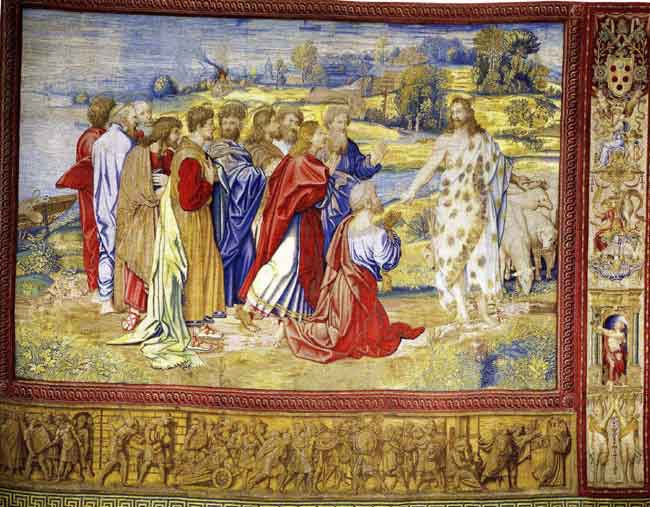
One of Ten Raphael Sistine Chapel Tapestries - Christ's Charge to Peter
The Raphael Tapestries were designed in Rome by Raphael and made Bruges by the leading weaver of the day, in the early sixteenth century. There was a recent, much acclaimed, V&A exhibition on the cartoons or drawings   which showed them off beautifully - comparing V&A's cartoon/drawing with the Vatican's real thing. I have written about a Black in one of the Tapestries.

My question has now been answered however not by any Wikipedia correspondents but by The Pope App from Vatican News on my iPhone!

Cardinals in front of the Faux Drapery
I have the pictures you see here of the Chapel set up for the Conclave taken from The Pope App, which allowed the images to be shared on Facebook, Twitter or by email. And oddly, sadly there are NO Raphael tapestries to be seen.  The faux drapes are there -  remaining uncovered, exposed below the Florentine frescos looking, to my eye, a bit lost and out of place in all the glory of the Chapel and Cardinals. 

You would think on such an illustrious, historic occasion the Chapel would be dressed in all its finery – in its very best.

Chapel and Cardinals
Still it does look good with Michelangelo’s inspirational ceiling, his awesome Last Judgment and the beautiful frescos from fifteenth century Florence’s finest painters all set off by the Cardinals in their dramatic red robes to great effect.


A wonderful sight – pure theatre on the most breathtaking stage - bring on the white smoke!

BTW how BIG must the occasion be before they bring out the Raphael Tapestries?!

Black Magus in Birmingham


Adriaen Isenbrandt  Adoration of the Magi Triptych  (1510-12)
I had an hour or so to spare in Birmingham,  last Sunday so decided to visit its Art Gallery to see if any Renaissance Blacks were to be found.

It was quite easy, perhaps too easy, as the Gallery's paintings and sculpture were laid out chronologically. In its Medieval and Renaissance room I found an Adoration scene by Adriaen Isenbrandt (c1490 to 1551) with a characteristic Black Magus complete with earring. He was in a Adoration panel flanked either side - dexter (right!) panel The Annunciation and sinister (left!) panel The Circumcision. 


Adriaen Isenbrandt  Black Magus Detail
Isenbrandt‘s realistic, naturalistic style with much exquisite detail in all parts of the composition, in oil on oak, follows the style of two previous generations of Bruges artists :                      

1st  Generation Jan Van Eyck (c. 1395–1441) 

2nd Generation Hans Memling (1430 - 1494)

3rd Generation Adriaen Isenbrandt (c1490 to 1551)

The Black Magus presence most probably came from Isenbrandt‘s awareness of Hans Memling’s (1430 - 1494) influential Adoration work (see below), as Memling had done , for me, the definitive work that introduced the Black Magus presence into the Adoration composition to other Netherlandish artists of the period.

Memling’s Adoration was itself a variation of a work by his master Roger van den Weyden (c1400 - 1464) - van Wyden’s foppish young, White Magus is  substituted - fifteen years later - by Memling for an equally flamboyant young but Black Magus.

Rodger van den Weyden, Adoration of the Magi, oil on panel, c.1455

Hans Memling, Adoration of the Magi, oil on panel, c.1470-72,

Netherlandish rtists such as Hugo van der Goes (1440- 1482), Hieronymus Bosch (1450-1516) and Gerard David (active 1484; died 1523). Just like Adriaen Isenbrandt seem to have been aware of the Memling altarpiece with its Black Magus.


So, Adriaen Isenbrandt's Adoration Tryptch with its Black Magus takes its style from fifteenth century Bruges artistic traditions and its composition from Hans Memling to create a colourful, pleasing and typical Adoration with a Black Magus.

Adriaen Isenbrandt  Adoration Triptych Detail


Adriaen Isenbrandt  Adoration of the Magi Triptych (Detail) (1510-12)

Saturday, 9 February 2013

V&A’s AFRICA: SPEED SEARCH SOUND


Sadly, I never had the chance of my three minutes of fame, to be repeated three times, as part of the V&A’s AFRICA: SPEED SEARCH SOUND.

Feb 1st was, for me,  a chaotic day as I was exchanging and completing on the sale of my house on the same day having been given five days notice - or the deal was off!

There’s a cynical old project management saying - because half the time has passed does not mean half the job has been done. I've been selling my house for some time, so in principle I should have been set to go. Nevertheless there was much to do on that last day in order to hand the keys into the estate agent by 4pm that Friday and go on to be at the V&A for 6pm, for my three by three minutes of fame.

In short: happily, I made the former deadline, sadly, I missed the latter. The folk at the V&A where quite understanding and sympathetic, nevertheless I felt very bad, having let them down and I was personally,very disappointed.

So, for the record here's what I was going to say in my three minutes - the transcript of my three minutes.
 
This is a selection of 33 from 400 photographs by Walker Evans, a 32 year old American photographer who was commissioned by New York’s Museum of Modern Art – MOMA - to produce the photographic record of the objects displayed in the Museum’s 1935 exhibition – African Negro Art. 

Walker was noted for his photographs of sculptor, he documented the Depression and became one of the most influential photographers of the 20th century.

At the time MOMA was just six years old and was seeking to establish itself as THE gallery in New York to see Modernist painting and sculpture.

In African Negro Art MOMA wanted to demonstrate African Art’s influence on those Modernist sculptors and painters.

The curator of African Negro Art clearly saw that influence of African Art as he wrote about its :

...sensitiveness to material, freedom from naturalistic imitation and boldness of imagination [which] parallel many of the ideals of modern[ist] art.

That influence of African Art can be seen in Picasso’s Mademoiselle D'avignon; many believe him to be the greatest modernist painter and this his greatest work.
  
Handout to audience
The 600 plus works  came principally from west and central Africa - an area about the size of the United States, on loan from private and public collections across Europe and America including Picasso’s lifelong friend Henri Matisse, as well as Picasso’s dealer and champion Daniel Khanweiler but oddly no pieces from Picasso, himself.

The V&A’s curator's presentation of MOMA’s photographs shows how African Art can be both Art and Artifact – on one hand an object for aesthetic contemplation on the other an object of archaeological interest so the same objects may be exhibited in Art Galleries and Ethnological Museums. 
Documented Artifact - Archaeological Interest
Documented in a photograph with a number and label as an artifact, like a police mug shot or creatively lit and sensitively photographed by a leading photographer, mounted and framed as an art object – African Art is open to ambivalent understandings.
Framed Art Object - Aesthetic Contemplation
It is African Art’s supernatural combination of the sacred and the secular, the mysterious and the mundane that MOMA and modernist artist sensesed and for you to discover for yourself: African Negro Art -  Art or Artifact?

Thank you


Tuesday, 8 January 2013

Preparing for AFRICA: SPEED SEARCH SOUND


From MOMA collection - Les Demoiselles d'Avignon by Pablo Picasso (1881–1973)

While preparing for my talk I found that MOMA has its press releases on line so, I was delighted to discover the series of releases from February thru to March 1935 which led up to the opening of its African Negro Art exhibition and the commissioning of the photographs of its exhibits by the young, up and coming photographer of sculptor - Walker Evans.

The releases revealed (amongst other things):

The 603 pieces came from Europe’s African colonial powers – England, Germany, Belgium and France – and from some American collectors.

The list of collectors who loan work included:

The Artist                Henri Mattisi (Picasso's life long friend)
The Art Dealer        D H Kahnweiller (as well as his dealer, he championed Picasso)
The Museum            Musee d’ Ethnographie , Paris (Picasso visited here in 1907)

All very closely associated with Picasso – and yet Picasso denied ever having been influenced by African Art!
From V& A Collection: Polychrome mask, Ivory Coast, Walker Evans, 1903 - 1975

I recall visiting the Picasso Museum  in Barcelona which had a display dedicated to his figurative design development of the mask shapes found in his seminal 1907 work Les Demoiselles d'Avignon. According to the drawings this development was based solely on the leaf as inspiration shape for the face – nothing to do with African Religious Masks.......

An alternative source for the masks in Picasso’s work is given by Ingo Walther in his Picasso Monogram for Taschen. In which he argues Picasso discovered the figurative design for himself , by himself. Walther uses a 1907 sketchbook as proof.

I am not persuaded, I believe Picasso was principally inspired by the African religious masks he saw at the Ethnographic Museum in Paris which he visited in 1907.

Meanwhile the research and preparation continues.

Thursday, 3 January 2013

Speaking at the V&A


I have been invited to speak at Victoria and Albert Museum's AFRICA:SPEED,SEARCH, SOUND Feb 1st. I have chosen to talk about Walker Evans's 1935 'African Negro Art' photographs for MOMA.

Looking forward to discussing what's the difference between art and artefact between Oxford's Pitt Rivers Musuem and London's Tate Modern presentation of 'African Negro Art'.