Sunday, 6 December 2009

Blacks still under warps even at the new V&A MedRen Wing

I was very disappointed to find on my first visit to the V&A’s new Medieval and Renaissance wing only to find the one piece I really wanted to see - A della Robbia ceramic altar piece with its black in the Magi procession - was the only piece still not on full view to the public, as you can see in the picture below.

From Della Robbia


I wanted to see it ‘live’ as it was one of the three pieces I considered for my essay, I wanted to write that the black and rear of della Robbia’s Magi’s procession. It was eliminated because at the time – June 08 – I couldn’t see the work as it was in pieces in storage not accessible to the general public for health and safety reasons .

There were two restorers working on the piece one of who was kind enough to take these close up pictures of the black for me:

From Della Robbia


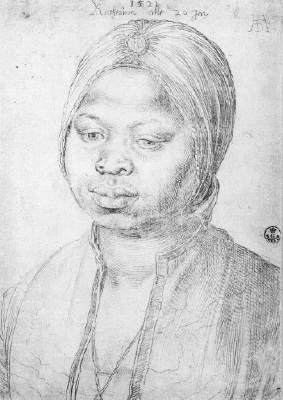
What a delight to see a sensitive and thoughtful bust of a black with much evidence of della Robbia’s possible contact with blacks – the broad nose, the fleshy lips strong cheek bones. One could speculate that this black was known to della Robba perhaps as a his own or a friend’s or patron’s slave or servant. This working is characteristic of artist who have actually had personal contact with the blacks they portrayed: such as Durer’s beautiful 1521 drawings of The Negress Katherina. the servant of the Portuguese factor João Brandão in Antwerp, when she was aged "20 Jar," according to the handwritten note (copyright http://www.wga.hu/). This quality of work is in direct contacts to the primitive coarsely worked black in the Rood screen.

From BHM2K8

Friday, 4 December 2009

The V& A's MedRen Wing and Obama Style Sponsorship

The Victoria and Albert Museum new Medieval and Renaissance Gallery is visually stunning, stupendous and sensational but is totally lacking in any interactivity, relying for its information on the tired, worn-out media of the small printed wall plaque, pathetically supported by a limited number of bigger print versions. Such plaques where fine in 1959 but this is 2009; television was the cutting edge information media then today it is the mobile phone and internet. The V&A have completely ignored the interactivity possibilities of today’s media.


In doing so the V&A has missed a trick and maybe a generation. No interactivity; no mobile phone; no Internet; no back channel. It is all one way. The V& A is talking – you listen! It doesn’t work – sorry. Yes it looks great but what did the works mean in their day and exactly what do they mean to us in the twenty-first century.

The V&A has missed a sponsorship opportunity. Yes it has been successful in attracting wealthy sponsors but that is not were its sponsorship could come from. The model, today, has to be Obama’s 2009 election campaign - millions of tiny donations rather than a tiny number donations of millions. Why couldn’t the V&A offer the interactivity of a work as a sponsorship opportunity?

Here’s how it will work.

The V&A chooses its preferred near field interactive media. There are a number to choose from Bluetooth, RFID, mobile phones. Wi-Fi each has its good and bad points but that’s not the issue - V&A decides on its preference, then offers at price (or revenue share) the sponsorship of the interactivity of each or selected works.

The V& A needs to move its display policy from the twentieth to the twenty-first century. It is required by law to widen its appeal and its needs more money so why not resolve both issues and broadened its sponsorship base .How ? By offering that sponsored interactivity of selected works.

Saturday, 20 December 2008

Dürer's 1504 Black Magus and a 1904 copy

The tradition of the black magus seems to be very much alive to this day. I was in Germany  last week attending my company’s Christmas Party, which gave me the chance to visit not only Dortmund’s wonderful Christmas Market but also most serendipitously an Antique Fare – Dortmunder Antik & Sammlermarkt. (Antique and Collectors Market)

In the Fare a vast shed full of stalls selling all things ‘antique’ from those of dubious origin and quality to exquisite sixteenth original century paintings and sculptures along with all the bric a brac in between.. A wonderful place to spend a morning browsing…but I only had an hour.

I was hoping to find a black magus - I wasn’t disappointed….
On Mr Klaus Hömberg (www.galerie-hoemberg.de) stand there was a seventeen piece nativity with a black magus. But not just any black magus this was after Dürer from his Adoration.

Albrect Dürer, (1504) Adoration of the Magi Oil on wood, 100 x 114 cm
Galleria degli Uffizi, Florence picture copyright Web Gallery of Art http://www.wga.hu/detail/d/durer/1/04/2adorat.jpg

The posture of the three kings was an exact copy of Dürer’s – the bald, kneeling older king crown on the ground ; the upright bearded, middle king and young, black magus – gift in their right hand with there cap in the other.

As for the date MrH said it dated from the early twentieth century so I took a poetic liberty and dated it at 1904.


The work is of really good quality as seen in middle king which was an image of Dürer as was Dürer’s self portrait in his original Adoration’s middle king.


Mr Hömberg offered me the complete 17 set piece at 180 Euro – with the exchange rate at 1.1 to the pound was little too much for me but really a small price to pay for such a wonderful piece of German/Black Magus history.

Tuesday, 9 December 2008

A Result and the Way Forward


Despite the fact the OU said the result would be posted on the 12th Dec they where actually posted today  9th Dec ’09 – a friend who works for the OU gave me the tip...........and yes I passed ....and the mark for the essay  was excellent, I’m really pleased ....so what’s next ?

I’ve signed up for AA318 but not really looking forward to it as I am troubled by much of post modern art..... Hurst, Emin et al as I’ve no desire to be shocked I want to be stroked, loved and cared for...as there’s enough angst in my life and the world for me not to need artist reproducing these themes in their  art for me. I’m trying to get on an OU  MA course where I can develop some of the ideas from the Essay.

Meanwhile I’m enjoying the pass and the  Essay mark!

Saturday, 13 September 2008

Well that’s it …...

...............just posted the essay; three copies

first class to Milton Keynes.

I feel a bit empty now, as the essay has consumed all my spare time for the past few weeks. A voyage of discovery which I found very fore filling.


So what’s next ?

The result comes out in December and my next course starts next February AA318 Art of the Twentieth Century But that’s another blog….BFN

Friday, 12 September 2008

The Conclusion - ‘not one of us’

To conclude, this investigation set out to answer three questions: what was work’s function; how did its image reach England; how was that  image viewed? On one level there are quite straight forward answers. The work was part of a Devon roodscreen as seen by comparisons with extant roodscreens. The movement of the image of the black Magus across Renaissance Europe is best explained by Burke’s   ‘communicative events’ idea witnessed in twelfth century Holy Roman Empire’s encounter with Islamic Spain, and the Empire’s subsequent cultural, economic and artistic  encounters between Germany, the Netherlands and England. The Adoration image spoke of the relationship between Church and State, Christ and Gentiles. There is however a fundamental paradox here as the only blacks known at the time were stereotypically slaves yet here was the image of a flamboyant, fashionably dressed black Magus/King at the physical and spiritual heart of the church, the epicentre of village life. Perhaps this image was how a definition of whiteness crystallised in Renaissance Europe as white Europe defined itself in terms of a white civilised Aristotelian taxonomy in direct contrast to the black barbarian , who even as king the black was different, exotic, ‘other’ – ‘not one of us’.

Sunday, 7 September 2008

Blacks In Renaissance England

Despite the fact that no black King visited England during the period there was a well understood iconography associated and attitude towards blacks.

Prof Kath Lowe in her article in Black Africans in Renaissance Europe (BTW this is the book the Blog takes its name from the acronym of the book’s title) looked at travel journals, costume books, legal documents, paintings, jokes and books to understand how blacks were viewed –to determine what was the instinctive cultural response to blacks at the time.

There were two broad areas of difference - blacks were seen as slaves as these were the only blacks known to the majority and that they were culturally inferior. Aristotle argued there were the civilised and the barbarians, he determined a list of criteria by which the former could be accessed. Black Africans fail on every count for example the civilised wore clothes according to Aristotle , and the style and quality of their clothing, through sumptuary laws, reflected status in society. Black African went around naked so they must be totally uncivilised - barbarians!

Culturally blacks were stereotyped:
  • They had body marks and wore gold jewellery
  • They lacked appreciation of civility and civilisation being: lazy, irresponsible, sexually promiscuous, drunk and prone to criminality..and seen laughing public!
  • They could only do certain jobs: those requiring physical work , horsemen, swordsmen, guards, musicians, dancers.
Some of these attribute can be seen in the black Magus reflecting the dichotomy in the image of the Black Magus as King and the reality of the black as a barbarian and slave.