Sunday, 11 December 2022

The Met's Prayer Bead Is About Prophesy

While researching The Met’s site for images of the Queen of Sheba I came across what they entitle: Prayer Bead with the Queen of Sheba Visiting King Solomon and the Adoration of the Magi a two inch, when closed, boxwood sphere. It is described as:


The stories paired here both concern rulers coming from exotic and faraway places to honor a greater king. To emphasize the similarity of the narratives, the carver has deliberately drawn visual parallels between them. Though the inscription ringing the outside of the carving mentions the train of camels that the Queen of Sheba brought, they are nowhere in sight when the bead is opened. Rather the action is indoors, with the queen and two other women offering gifts, just like the three Wise Men in the scene below. The small dog under the table in the lower bead is typical of the small details that the artist inserts to enrich the scene.


I would argue The Met has missed a trick here.


This extraordinary piece is not just about pairing images of rulers honouring a great king , it is not just about emphasizing similarities. It is about prophesy. Prophesy fulfilled in Jesus as king of the Jews.  The Old Testament king of the Jews – Solomon - being honoured prophesying the New Testament king of the Jews – Jesus. 


The Queen of Sheba visit in the Old Testament is seen as anticipating the Three Kings visit in New Testament. This prophesy is seen in 14th century Biblia pauperum so called Paupers’ Bibles such as the example below, from the British Library’s collection.


Miniature of Abner visiting King David; miniature of the Adoration of the Magi; 
the miniature of the Queen of Sheba presenting gifts to Solomon, Northern Netherlands 
(The Hague?), c 1395-1400, Kings MS 5, f. 3r

Old TestamentNew TestamentOld Testament
Abner visiting 
King David 
Adoration of 
the Magi/Three Kings
Queen of Sheba 
presenting gifts to Solomon


The Paupers' Bible were picture Bibles where Images, rather than text, they followed a fairly standard layout. At the centre of each sheet is usually a scene from the New Testament, flanked on either side by an Old Testament scene related to that central image  by typology. Typology being a brand of Biblical exegesis or study which was extremely popular in the medieval era, which centered on the belief that people and events in the Old Testament could be viewed as prefiguring or anticipating aspects of the life of Christ.


The description of the The Met’s prayer bead need to reflect the religious significance of the piece not just the physical and visual.

Saturday, 1 October 2022

Review: Chinonye Chukwu’s TILL : Released Oct 1 '22

Emmett Louis Till (Jalyn Hall) and Mamie Till-Mobley (Danielle Deadwyler)

Till on IMDb


 When I first received the email invitation from Universal with the subject **First Look Screening Invite** - Chinonye Chukwu’s TILL I was not impressed. I knew the story of Emmett Till a 14-year-old African American boy who was abducted, tortured, and lynched in Mississippi in 1955, after being accused of offending a white woman. I didn’t want to see what I believed would be its violence re-enacted – no matter how noble the intent. 

Having just read Paterson Joseph’s The Secret Diaries of Charles Ignatius Sancho I very much agreed with the point made in its introductory Author’s Note, which I paraphrase here along with my emphasis:


To the expectations of the [viewer] who awaits a [film] filled with whips and curses and rapes and murders of Black People by White People …… you will not find much to please you here. 


I never went to Django Unchained or 12 Years A Slave and I turned The Harder They Come off after a few minutes. I didn’t want see any of the racial violence, the blood, the gore, the pain. I don’t do, what to me, are exploitation movies packed with gratuitous bloody violence. I do not wish to see graphic ‘murders of Black People by White People’ no matter how just or significant the film maker’s cause. 


So, my immediate response was to decline but my partner liked the idea of a night back in London town at the movies, especially invited by Universal to a screening. So, very reluctantly I accepted the invitation.


I was so pleased I took her advice. TILL is a brilliant movie with deep emotional messages in almost every scene. 


From the opening we’re introduced to impish, playful Emmett Louis Till (Jalyn Hall) with his teenage world view and his loving mother, Mamie Till-Mobley (Danielle Deadwyler) full of love and concern that he should do the right thing. Their relationship is at the heart of this movie – a mother for her only son – a son wanting to be a young man – and her need to protect him from all the deadly perils of 1950s America that lay in waiting for Black men. We see the joy, the love, the hurt the pain through his mother’s reactions and emotions. 


TILL shows how she maintains her dignity under pressure from the Whites who want to destroy her reputation and her story, just as they had physically destroyed her son, but she is emotionally strong, fighting for a greater cause than the Southern Whites will ever know or comprehend - justice for her son, born of her love for her only child. 


I was emotionally exhausted at the end of this movie. 


It’s the movie of a 1955 incident which resonates to this day. You can clearly see how Emmett’s death can be seen as a galvanizing moment that helped lead to the creation of the civil rights movement. Sadly, it contains civil rights messages that resonate today almost seventy years later – Black voter suppression, the rewriting of history in favour of Whites things which are happening even today. 


The central story of TILL, a White woman - Carolyn Bryant - lying about a Black man’s supposed inappropriate behaviour has an equivalent today but this time a much happier outcome for the Blackman. In 2021 the New York Times reported a White woman called the police in Central Park claiming she was being attacked by a Black man, he filmed the whole incident showing she was clearly lying he, unlike Emmitt survived to tell his story. 


TILL is a movie the world must see. Not just to make manifest the racial violence that continues to this day in America seen in the death of George Floyd but also to make real that force of nature that is the unconditional love of a mother for her son.


Sunday, 25 September 2022

Review: Keshia N. Abraham & John Woolf (2022) Black Victorians: Hidden in History


I had the pleasure of being sent an advance reading copy of Black Victorians: Hidden in History. The introductory email claimed “Black Victorians explores the intersections between Black history and British history in the nineteenth century, with a focus on human stories as a vehicle for illuminating Victorian attitudes to ‘race’. “ 

Most of the ‘human stories’ covered I was familiar with as I recognised many of the characters where names I knew from Peter Fryer’s seminal text Staying Power. What was different with Black Victorians were the connections identified and discussed between the individuals and Victorian society. This was to me a particular strength of the book as it wasn’t a series of unrelated biographies, not a series of stories about Black exceptionalism rather the individuals’ histories are given context in aspects of  Victorian society - Part 1 Struggle and Survival , Part 2 Church and State , Part 3 The Arts and Part  4 The Fight for Freedom – which made identifying and understanding the books intersections between Black history and British history easy to follow through ‘rooting lives within braoder networks, milieus and contexts’. 


It was the names under Part 1: Struggle and Survival that introduced a new context to me, Broadmoor: the criminal lunatic asylum, clearly demonstrating the book’s ability to tell a Black history beyond the conventions of Black exceptionalism. I recognised none of the names I was taken out of my Black British history comfort zone in which to varying degrees I knew most of the characters in the other Parts, in Part 1 I knew none.


Part 1 gives an account of the disabled: Edward Albert from his own brief memoire and his appearance in London Labour and the London Poor (1851-65) where he is described as ‘The Negro Crossing-Sweeper, Who Had Lost Both His Legs’. And the lives of three Black inmates of Broadmoor, England’s first lunatic asylum for the criminally insane from its records:  John Flinn spent forty seven years inside Victorian institutions, dying in Broadmoor, William Brown an ex-seaman who murdered his wife by cutting her throat, tried to kill his stepson, set fire to the house then tried to commit suicide by cutting his own throat – he was found not guilty by reason of insanity, he died in Broadmoor and Joseph Peters who seems to be have driven insane thru isolation following the death of his only relative his mother was sent to Broadmoor after being declared insane following an attack on a shipmate. Each was given the opportunity to tell their story in their own words, stories once lost in the archives have resurfaced. The Black Victorians considered in Part 1 demonstrate how their stories endure in the archives, stories of the fight for survival from the margins of society contrasting with those discussed in the other parts who were not at the edge but moved within the establishment or protested against its structures.   


I was particularly interested in the analysis of responses to Victorian racism. The celebrated actor Ira Aldridge was hounded by the British press having to continually fight for equality both on and off the stage ‘forever confronting the racist depictions of African Americans in the form of the minstrel.’ While Aldridge accepted that racist criticism, the escaped slave and abolitionist William Wells Brown would not accept criticism. When a newspaper ‘described his exhibition in contemptuous terms, and thereby materially curtailed the receipts’. He successfully sued for libel and awarded £100. The probable racism within the criticism was ignored by the national press who focused on ‘benign British justice.’ 


The highlight of the book for me could have been the chapter – Land of Hope and Glory – which went some way to setting the scene for the Victorian attitude to race. I was minded of Fryer’s seminal Chapter 7 The Rise of English Racism in Staying Power which covers similar ground. I would have hoped for deeper analysis in Black Victorians of the impact of development and growth of the British Empire following abolition of the slave trade. The 3Cs – Christianity, Commerce and Civilisation – that drove Victorian expansion of Empire in Africa leading to the destruction then looting the treasures of the Benin Empire in Nigeria, Ashanti Kingdom in Ghana and Maqdala in Ethiopia. I would have welcomed some analysis of Victorians in Africa and growth of its Empire. What impact if any did it have on the attitudes of Black and white Victorians?


I enjoyed the chapter on the Pan-African Movement in which we can see how the eighteenth-century British abolitionist organisation the Sons of Africa could be linked a century later to Pan Africanism.  Pan-Africanisms is shown as a global movement with the delegates to its 1900 conference in London coming from around the world to discuss, slavery, colonialism, racism and ways to fight these global scourges. One delegate celebrated the ‘common cause’ among people of the African Diaspora, another prophesised “America would never be at peace with herself until the negro problem was settled outright” showing how the ideas of Black Victorians still resonate today.


Setting aside the need for perhaps more on Africa and Empire Black Victorians gives insights into the intersection of between Black history and British history through some very human stories in a very readable, accessible format, free of the conventional exceptionalism approach to Black history. Black Victorians gives wider more holistic understanding of the Black presence in Victorian Britain, which I very much enjoyed reading.


Footnote

I've yet to see a copy of the final version ...they may have corrected the omission on the Victorians in Africa addressing "What impact if any did it have on the attitudes of Black and white Victorians?"


Footnote to Footnote

I received my final copy as promised and yes they did address Victorians in Africa in the context of chapter Land of Hope and Glory:


Treasures were looted (and kept to this day), including from the Mandala in Ethiopia, The Ashanti Kingdom in Ghana and the Benin Empire in present-day Nigeria. Uprisings were viciously suppressed and natural resources exploited, while people starved (page 33)


and thanks to the authors for the mention in Acknowledgements


Wednesday, 8 June 2022

Where'd Me Dad's Love of Country Music Come From ?

 I met the musician and educator professor Nate Holder at the Black British Book Festival we had a good old chat black music and history exchanging ideas and views. It was my chance to share how I’d just solved the one of the great mysteries of my childhood:

My Dad, Michael N. Ohajuru (1926-1995) (left) Jim Reeves (Right)

Why did my Dad – a seaman from West Africa - have a fondness for the music of American country and western singers like Hank Williams and Jim Reeves ? Every time I hear Jim Reeves I Love You Because, I’m back in our front room in Liverpool.

Dad passed away in 1995 so he’s no longer here to ask. The mystery was cofounded by Dr Michael McMillan and his seminal Front Room project, as I recall discussing with Michael the huge radiogram the centre of his painstakingly wonderfully reconstruction of an African Caribbean front room from the late 1960s and 1970s. The radiogram I knew was a huge piece of brown mahogany furniture which served as a radio, a record player and album storage unit, we had in the front room of our terraced house in Liverpool.

Michael McMillan - A front room in 1970 - The Museum of The Home
Photograph by Em Fitzgerald

Amongst Dad’s album collection which was mostly West African high life music whose album covers featured black African faces, many with titles in African languages. Incongruously there were several albums whose covers had smiling white male faces most times with cowboy hats and titles like The Very Best of … or The Greatest Hits of … As I type I can hear Jim Reeves classic, I Love You Because being played on the radiogram in our front room. Discussing this with Michael Macmillan I learnt that other Black parents had a penchant for playing country & western music on their front-rooms’ radiograms. Why country music was as mystery to me.

Having listened to BBC Radio 4’s Soul Music ‘Take me Home, Country Roads’ I now know why.

Soul Music celebrates music from many different genres from classical to pop that touched folks’ souls with their powerful emotional impact. It was listening the episode featuring  John Denver’s Take me Home, Country Roads I learnt how Black folk of my Dad’s generation connected with country & western. The author of Sounds Like London: 100 Years of Black Music in the Capital Lloyd Bradley explained how at first the reggae version by Toots and Maytals seemed enigmatic to him - a Black Jamaican band playing white, red-neck American music – an enigma I shared with Lloyd,  trying to understand my Dad’s country and western music tastes.

The show explained that Caribbean government run radio stations of 60s were staffed by those trained at the BBC.  The motherland’s BBC was the model to be followed, as country and western had no part of the BBC’s musical canon at that time it didn’t feature. But it did feature on the many American radio stations whose signals could be picked up in Jamaica. That coupled with how country and western song lyrics spoke to things familiar to country folk, it became popular throughout the Caribbean.

Country Roads is ‘about the longing for home and the desire to be back with the people you love’ Toots substituted ‘West Jamaica’ for ‘West Virginia’ as he sings of country roads taking him home to the place he belonged.

Liverpool or more specifically Liverpool 8 today known as Toxteth, in the 1960s it was a bustling multicultural, multiracial inner city suburb. My Dad had Caribbean friends, they went to each other’s night clubs and shebeens so exchanged ideas and music freely - no surprise my Dad found country and western music.

So, there you have it, mystery solved! .....

My Dad – a seaman from Nigeria - love of the country and western music he played on the radiogram in our front room in Liverpool can be traced back to American radio stations of the 60’s broadcasting country and western ‘Soul Music’ across the Caribbean. 

By coincidence I came across another BBC programme - Black Roots -which charted the rise and fall and rise of the Black American influence on country & western music- how Black folk shaped the genre. Rhiannon Giddens the programme's presenter discusses her life and the challenges she's had as a Black, award winning, female banjo player while discussing with guests how the banjo, originally an African instrument became a mainstay of country & western music, while many of the early celebrated fiddle players were Black and the one earliest and most beloved harmonica players was a Black man.

Rhiannon Giddens 

Black Roots: Grammy-winning musician Rhiannon Giddens explores the history of African American roots music through the story of forgotten black pioneers.   

Black Roots showing in music, what comes around goes around from the Black Americans in to White Americans in the nineteenth century  to the Black folk in the Caribbean to a West African seaman in Liverpool in the 1960s.

With big thanks to Nate Holden, Michael McMillan, Lloyd Bradley and the BBC.


Monday, 29 November 2021

Review: BLACK - a graphic bio of Tobias Taitt with graphics by Anthony Smith


Tobais Taitt's graphic bio BLACK is the second book I've read in as many months that tells a harrowing story of the cruelty and brutality being brought up in the English care system in the 80s and 90s with a teenage boy search for sex and love in an uncaring, indifferent world. Where Malik Al Nasir's story in Letters To Gil is a story ending in purpose and direction with his twin careers of music and education despite being brought up within the barbarity of the care system I wrote a review for Goodreads.  BLACK ends with a profound teenage revelation leaving us to  speculate on his adult life and career


Tobais's  story like Malik has a challenging family background but not as desperate - Malik had a confusing homelife with one father with two wives, Tobais's mother had eight children by eight different fathers, he was the seventh , she was divorced four times and murdered one husband in revenge for murdering her brother by pouring boiling oil over his head while he sat in a bath after allegedly raping her. 


The narrative is very candid, often sad as we read of Tobais isolation in response to his mistreatment by an uncaring system and his resulting anger and rage - there are a few moments of happiness but there are often short lived as the uncaring system takes over with the equally cruel and and brutal police often close at hand to regulate Tobais's behaviour. One scene that struck home with me was his rejection by his first crush following her rejection after taking him home to meet her parents 'The reason?  I was black and her father didn't like it' A scenario many young black boys like myself are familiar with.

Anthony Smith's graphics are innovative including a wonderful homage to  Kerry James Marshall's A Portrait of the Artist as a Shadow of His Former Self. His portrayal's of Tobais's emotions, his inner thoughts  and his rage are compelling, totally convincing. The text and graphics work well together as drills down to make a point ...told brilliantly in the last few graphics as Tobias has his epiphany. I will not reveal it, I leave it to you to read and be as moved as I was. 

To conclude a good looking, very readable book - a page turner - I read it in two sessions. When one reflects on one's own childhood and its perceived difficulties then reads BLACK telling of  Tobais's upbringing in care it makes one  realise just how fortunate so many of us are. A sober, but highly recommended read. 


Saturday, 5 June 2021

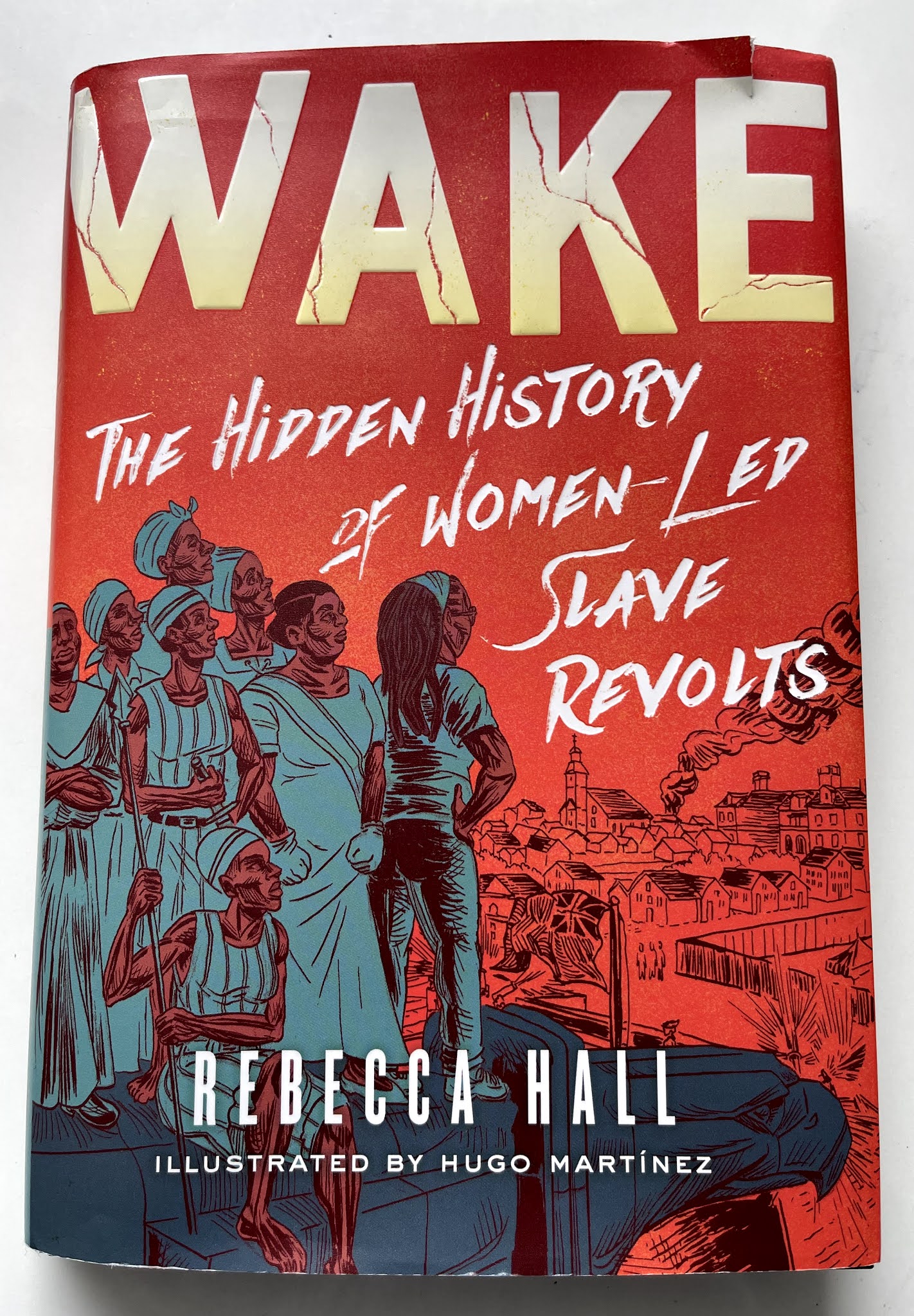
Review: WAKE:THE HIDDEN HISTORY OF WOMEN LED-SLAVE REVOLTS


It was not until I was reading the acknowledgements that I was reminded that I’d helped in a very small way to make this important and wonderful book happen - Rebecca Hall’s WAKE:THE HIDDEN HISTORY OF WOMEN LED-SLAVE REVOLTS  with illustrations by Hugo Martînez published June 2021.  Rebecca writes ‘I also joyfully thank all of Wake’s supporters on Kickstarter’ I was one of those supporters in 2018.


 Wake's Kickstarter Proposal (2018)


The book’s subtitle, for me, uses the descriptor hidden for Black history correctly. All too often Black history is described as hidden, forgotten, untold and so on , implying some agency denying the history being  brought to light when all that’s required is an enquiring mind and a few moments with Google. However in this case Rebecca’s history is really hidden – the history of Black woman. I know this from the work on my presentation on the Queen of Sheba from the Bible and Andromeda from the Classics both women were Black but were actively denied their Black identity - Misogynoir and the History of The Image of the African Woman in Western European Art
 

Rebecca tells a real hidden history one in which the deeds of men - Black and white – are noted while the acts of Black women most times go unrecorded. It’s in that unreceording, traces, clues are left of Black women’s presence and agency. Rebecca looks at eighteenth records of enslavement in institutions -  academic and commercial - on both sides of the Atlantic in an attempt to bring that Black women’s presence  to life, from delving into the uncatalogued records of the New York library to be being thrown out of the Lloyds of London archives being told ‘we decide who can see our records and for what purpose.’ 

It was the response of Lloyds that intrigued me, I was minded of the NY Times 1619 Project discussing the links between capitalism and enslavement  where it says: A majority of credit powering the American slave economy came from the London money market. Years after abolishing the African slave trade in 1807. I’ve written to Lloyds to find out more about that statement, more of that if and when Lloyds get back to me. 

She tells her journey to find the truth of the Black women’s presence, with as she says ‘with a measured use of historical imagination’ to tell the story behind the statistic that at least one in ten of the slave ships had a revolt on board and ‘the more women onboard a slave ship, the more likely the revolt. 

The book talks of the barbarity of the trade to women and their bodies. Rebecca writes of pregnant enslaved Black woman sentenced to death by hanging having her execution ‘delayed until after she gave birth because that baby was someone’s property.’ Of the heroism of the on-board revolts and of the ultimate self-sacrifices – the suicides of the Middle Passage. Stories, brilliantly and emotionally brought to life, then and now as we move in our mind’s eye from the eighteenth to the twenty-first century thro Hugo’s innovation in telling the story in graphic form.


Hugo’s illustrations artfully tells Rebecca's story innovatively, often with much emotion and realism. For example, relating her lived experience as Black woman on the streets of New York, being forcibly brushed aside by an anonymous twentieth first century suited White business man, hurrying by, brief case in hand, who doesn’t break his stride, rushing on, ignoring the incident; contrasting that with an eighteenth century White man doing exactly the same thing but with a whip in hand,  eerily reflected in a window.


Rebecca in deed tells a hidden history and thru Hugo’s innovation in illustration the story is brought to life. Wake’s an emotional, challenging, thought provoking book. I was profoundly caught in its wake, the wake Rebecca describes of the victors’ version of history which erases resistance. Hugo on every page of Wake makes that resistance visually real as Rebecca brings it back to life through her measured historical imagination. To conclude, I’m feeling quite pleased with myself, that in a small way I have helped make this very important and highly readable book happen – a must read.


Tuesday, 1 June 2021

Review: Chater, Kathleen. (2021) Henry Box Brown: From Slavery to Show Business,

Review Chater, Kathleen. (2021)  Henry Box Brown: From Slavery to Show Business, McFarland & Company, Jefferson, North Carolina, USA


Kathy’s highly readable latest book is the biography of the African American, fugitive slave, abolitionist and entertainer – Henry ‘Box’ Brown - born around 1815 into slavery on a planation in Richmond Virginia from where he conceived an ingenious  plan to escape enslavement – he would be mailed to freedom in a box to the free North. His plan worked, hence that middle name. Kathy describes how he wrote his autobiography, Narrative of the Life of Henry Box Brown, and commissioned a panorama, a series of anti-slavery images along with a depiction of his escape.


He toured with his box, the Narrative and panorama in the Northern free states before fleeing to Britain in 1850 following passing of the Fugitive Slave Act. Britain became his home for 25 years, where he married again and had a second family. Before the Civil War he toured Britain becoming a celebrated abolitionist, speaking out against slavery and its horrors. After the American Civil War, when his abolitionist anti-slavery message was no longer needed, he reinvented himself in order to earn a living, using the acting and enteraining skills he had developed touring to create Prof. H. Box BrownKing of the Mesmerists and The African Prince mesmerist and conjuror acts. He returned to America in 1875 and continued touring. He died in 1897 in Canada.


The book’s contents page reads like a play, making the book easy to follow and read, as well as to dip into. Kathy divides his life into three acts which each act having a number of scenes. Act 1 Liberty describes his early years, his escape to freedom and the start of anti-slavery touring, escaping the Fugitive Slave Act to Britain, ending with how he has to reinvent himself in the face of difficulties; Act 2 Partnership tells of his marriage, more touring and more changes as he develops other lecture subjects, including the Indian Mutiny, and finally Act 3 Magic tells of his life after slavery ended in America and his abolitionist story no longer needed to be told.


There are some nice personal touches such as when discussing why there are so few ‘women of colour’ to be found in the crime records. Kathy tells us this is ‘partly because women were (and are) more law abiding’ (my emphasis). As well as giving her opinion ‘The Welsh…tend to regard everything that comes from England as culturally inferior.’ 


Henry Box Brown is a very enjoyable book to read, diligently researched with an authoritative scholastic air yet still very accessible. Her many quotes and references are backed by detailed endnotes and a comprehensive bibliography. I particularly like the way Kathy uses sub headings to break the story up including  a Betteridge headline showing her journalist roots – ‘[Henry Box Brown] the First Magician of Colour?’  - I leave you to guess the answer.


If you are looking for an accessible introduction to understanding Henry Box Brown’s life and how a fugitive slave survived, even thrived on the anti-slavery lecture and presentation circuit in Victorian England alongside others such as Ellen and William Craft, William Wells Brown and Frederick Douglass, then this is the book for you. #Recommended.